Tuesday, February 26, 2019

The Huawei Fiasco Doesn’t Bode Well for Alibaba Stock

Alibaba (NYSE: BABA) has shown good growth numbers in the past few quarters from its cloud segment. In the recent quarter, Alibaba reported $962 million of revenue in cloud computing with year-on-year growth of 84%. This has had a positive impact on the sentiment around Alibaba stock. Cloud segment is a high growth business with a potential for good margins as shown by Amazon’s (NASDAQ:AMZN) AWS.

Alibaba stock BABA stockAlibaba stock BABA stockSource: Charles Chan Via Flickr

Hence, Alibaba’s management has announced their intention of focusing on cloud to drive future growth. CEO Daniel Zhang has also mentioned that cloud would be the main business of the company in the future.

But due to the trade tensions and the negative impact of Huawei fiasco, we could see additional scrutiny on Alibaba’s cloud expansion in several international regions. Financial Review has recently mentioned the security challenges faced by Alibaba in its cloud push in Australia. Similar issues will arise in Europe, Canada, India, and other regions.

Importance of Cloud Segment

The Cloud Computing segment of Alibaba is the fastest growing segment for the company. In the recent quarter, the revenue from this segment was RMB 6,611 million or $962 million, up from RMB 3,599 million in the year-ago quarter. Hence, the revenue share of cloud computing increased from 4% to 6%.

The EBITA margins for this quarter were negative 4%. This was a slight improvement from negative 5% in the year-ago quarter. Although all companies do not separately report their cloud revenue, Alibaba’s revenue pace puts it among the top players of cloud business. The industry leading growth rate in cloud is a major favorable aspect for Alibaba stock.

The company is rapidly setting up new data centers in international regions. It has recently opened two new data centers in UK and another in Indonesia. We should see a number of new opening in Europe and South Asia over the next few quarters.

Alibaba has the capacity to invest substantial amounts to improve the long term growth potential of its cloud business. The company can also decide to forego profits in the short term to provide more attractive pricing to customers. This should improve the market share and revenue growth at a rapid pace.

Last year, Wells Fargo’s Ken Sena estimated the standalone valuation of Alibaba cloud to be around $80 billion. If we look at the contribution to Alibaba’s ecosystem, the valuation could easily top $150 billion. This is over one-third the current market cap of Alibaba stock. Hence, any negative impact on cloud computing will hurt the bullish sentiment around Alibaba stock.


Compare Brokers

Trade Rhetoric and the Huawei Issue

Even if there is a win-win deal on trade issues between U.S. and China in the near term, the brand image of Alibaba cloud could take a beating. In addition, there has been the Huawei issue which is still unresolved. The sentiment against Huawei can be seen in a statement made by T-Mobile (NASDAQ:TMUS) CEO John Legere.

He said, “Let me be clear—we do not use Huawei or ZTE network equipment in any area of our network. Period. And we will never use it in our 5G network”

Corporate clients who are procuring equipment are more risk averse. They would like to prevent any upsetting of the business due to changes in the regulatory environment. The cloud computing business is different from 5G network but it also requires big contracts worth millions of dollars from corporate clients.

If these cloud providers want a risk-free cloud provider, they would always have an alternative to choose Amazon’s AWS or other tech companies.

The top management from Alibaba is yet to make a statement on this issue as they would be waiting for a favorable trade deal. However, investors need to look at the possible impact of these challenges on the long term potential of Alibaba cloud in international regions.

Options Available with Alibaba

Alibaba is trying to add new clients by aggressively pricing its cloud services. We can see this from the huge difference in the margins of Amazon’s AWS and Alibaba cloud. In the recent quarter, AWS posted an operating margin of 29.3% while Alibaba cloud showed EBITA margin of negative 4%. The company can continue to lower its prices in the near term to provide heavy discounts to clients compared to AWS.

Alibaba has also formed a strong partnership with Europe’s biggest department store, El Cortes Ingles. Alibaba would be providing payments supports, logistics, ecommerce and New Retail options to the Spanish company.

But the most important part of this partnership for Alibaba is the ability to add another big client for its cloud program. Having bigger brands on its client list should make it easier for Alibaba to add new clients in the future.

Alibaba is also a big cloud player in China where Amazon and Microsoft are very small. If a foreign brand wants to have a presence in China, Alibaba cloud would be the first choice. This gives the company a starting point to explore additional cloud service for these brands in their home country.

Impact on Valuation

The growth potential of cloud business in China is itself quite big. Hence, Alibaba will continue to deliver decent growth due to its domestic cloud services in China. But a few major hiccups in international regions could reduce the long term potential for Alibaba cloud. This should also impact the valuation multiple of Alibaba stock.

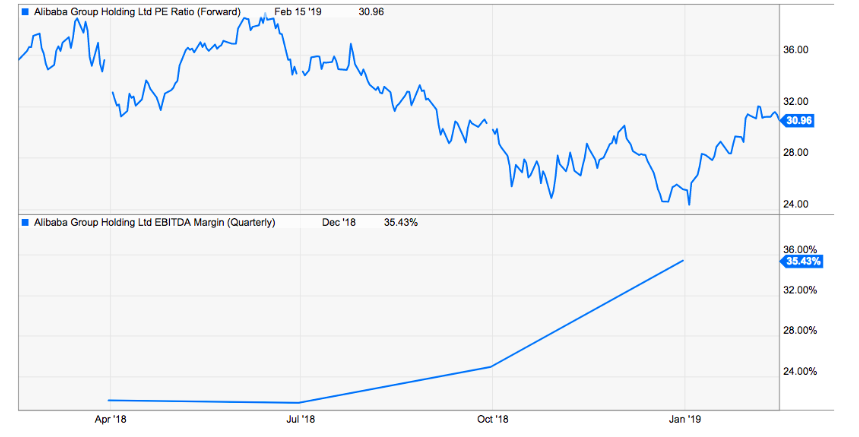
Alibaba stock is currently trading at forward P/E multiple of around 30. This is quite low for a company with revenue growth at close to 40% and improvement in EBITDA margins.

However, a big part of Alibaba’s valuation is tied to its ability to show continuous growth and improvement in margins in the cloud business. Investors need to watch the possible challenges faced by this segment to gauge the future momentum in Alibaba stock.

Investor Takeaway

Alibaba cloud could face security concerns similar to Huawei as it expands in international regions. The current U.S. administration has put pressure on allies to ensure that sensitive national infrastructure does not use Chinese technology. This will limit the usage of Alibaba cloud in many areas.

It also negatively impacts the brand image of Alibaba cloud. Corporate clients who are risk averse would rather pay a premium to get AWS or other cloud providers instead of using Alibaba cloud.

A long term trend towards poor reception of Alibaba cloud will limit the revenue growth of this segment in international regions. It will also force Alibaba in giving bigger discounts to lure clients which should reduce the margin expansion within cloud segment.

The cloud segment plays a vital role in the bullish thesis for Alibaba stock. Hence, it would be important to see how the management deals with any additional security concerns regarding its cloud business.

As of this writing, Rohit Chhatwal held no positions in the aforementioned securities.

Monday, February 25, 2019

GMR Infrastructure gains 2% as co to develop new airport at Greece

Shares of GMR Infrastructure gained 2 percent intraday Friday after company signed concession agreement to develop a new international airport at Greece.

GMR Airports, a subsidiary of GMR Infrastructure along with Greek partner TERNA Group has signed the concession agreement to develop a new international airport of Heraklion at Crete, Greece.

The scope of the project involves design, construction, financing, operation, and maintenance & exploitation of new international airport.

The concession period for the project is 35 years including Phase 1 construction of 5 years.

The entire project will be funded through a mix of equity, accruals from the existing airport, and financial grant being provided by the Government of Greece; therefore debt is not required in this project.

At 09:56 hrs GMR Infrastructure was quoting at Rs 16.45, up Rs 0.35, or 2.17 percent on the BSE.

For more market news, click here First Published on Feb 22, 2019 10:06 am

Saturday, February 23, 2019

Top 5 Biotech Stocks To Own Right Now

tags:ARQL,ALNY,AMGN,BIIB,

New York State Common Retirement Fund raised its stake in shares of Ligand Pharmaceuticals Inc. (NASDAQ:LGND) by 30.7% in the 1st quarter, according to the company in its most recent filing with the Securities & Exchange Commission. The fund owned 56,216 shares of the biotechnology company’s stock after purchasing an additional 13,219 shares during the period. New York State Common Retirement Fund owned 0.27% of Ligand Pharmaceuticals worth $9,285,000 at the end of the most recent quarter.

A number of other large investors also recently made changes to their positions in the stock. Municipal Employees Retirement System of Michigan raised its position in shares of Ligand Pharmaceuticals by 6.4% in the 1st quarter. Municipal Employees Retirement System of Michigan now owns 8,430 shares of the biotechnology company’s stock worth $1,392,000 after acquiring an additional 510 shares in the last quarter. Matarin Capital Management LLC purchased a new position in Ligand Pharmaceuticals in the first quarter valued at approximately $7,714,000. Tygh Capital Management Inc. raised its holdings in Ligand Pharmaceuticals by 3.4% during the 1st quarter. Tygh Capital Management Inc. now owns 50,514 shares of the biotechnology company’s stock valued at $8,343,000 after acquiring an additional 1,677 shares during the period. BlackRock Inc. raised its holdings in Ligand Pharmaceuticals by 0.6% during the 1st quarter. BlackRock Inc. now owns 3,013,829 shares of the biotechnology company’s stock valued at $497,763,000 after acquiring an additional 16,869 shares during the period. Finally, 6 Meridian bought a new stake in Ligand Pharmaceuticals during the 1st quarter valued at $703,000.

Top 5 Biotech Stocks To Own Right Now: ArQule Inc.(ARQL)

Advisors' Opinion:
  • [By Joseph Griffin]

    Shares of ArQule, Inc. (NASDAQ:ARQL) were down 5.4% during trading on Wednesday . The company traded as low as $4.71 and last traded at $4.73. Approximately 3,358,864 shares traded hands during trading, an increase of 289% from the average daily volume of 863,008 shares. The stock had previously closed at $5.00.

  • [By Joseph Griffin]

    ArQule (NASDAQ:ARQL)‘s stock had its “buy” rating restated by equities researchers at Needham & Company LLC in a research report issued to clients and investors on Tuesday, Marketbeat Ratings reports. They currently have a $6.00 price target on the biotechnology company’s stock, up from their prior price target of $5.00. Needham & Company LLC’s price target suggests a potential upside of 134.38% from the company’s previous close.

  • [By Max Byerly]

    Get a free copy of the Zacks research report on ArQule (ARQL)

    For more information about research offerings from Zacks Investment Research, visit Zacks.com

  • [By Ethan Ryder]

    ArQule, Inc. (NASDAQ:ARQL) insider Value Fund L. P. Biotechnology sold 1,035,939 shares of the business’s stock in a transaction dated Wednesday, May 30th. The shares were sold at an average price of $5.00, for a total value of $5,179,695.00. The transaction was disclosed in a filing with the SEC, which is available through this hyperlink.

  • [By Joseph Griffin]

    ValuEngine upgraded shares of ArQule (NASDAQ:ARQL) from a buy rating to a strong-buy rating in a research report released on Tuesday.

    Several other equities analysts have also issued reports on ARQL. Zacks Investment Research upgraded ArQule from a hold rating to a buy rating and set a $2.50 price objective for the company in a research report on Tuesday, March 20th. BidaskClub upgraded ArQule from a buy rating to a strong-buy rating in a research report on Saturday, March 24th. B. Riley set a $4.00 price objective on ArQule and gave the company a buy rating in a research report on Monday, March 26th. Leerink Swann upgraded ArQule from a market perform rating to an outperform rating in a research report on Thursday, April 5th. Finally, Roth Capital boosted their price objective on ArQule from $5.00 to $6.00 and gave the company a buy rating in a research report on Tuesday, April 17th. One equities research analyst has rated the stock with a sell rating, five have assigned a buy rating and two have issued a strong buy rating to the stock. The company has a consensus rating of Buy and a consensus target price of $5.35.

Top 5 Biotech Stocks To Own Right Now: Alnylam Pharmaceuticals Inc.(ALNY)

Advisors' Opinion:
  • [By Brian Orelli]

    The delay in an FDA decision for Tegsedi puts it behind competitor Alnylam Pharmaceuticals (NASDAQ:ALNY), which expects to hear from the FDA by Aug. 11 for its hATTR drug patisiran. But Sarah Boyce, the president at Akcea Therapeutics, doesn't think a few months will really matter: "We don't really feel that's going to have any impact and the drugs will be close enough together from a launch perspective. So not really [going] to make any adjustments, and we're very well prepared to be ready to launch following approval."

  • [By Stephan Byrd]

    Alnylam Pharmaceuticals (NASDAQ:ALNY) was downgraded by investment analysts at BidaskClub from a “sell” rating to a “strong sell” rating in a research note issued on Wednesday.

  • [By Brian Orelli]

    Alnylam Pharmaceuticals (NASDAQ:ALNY) and Ionis Pharmaceuticals (NASDAQ:IONS) looked to be in a two-horse race to develop TTR amyloidosis (ATTR) drugs. Alnylam recently got its drug Onpattro approved, while Ionis Pharmaceuticals and its marketing partner Akcea Therapeutics (NASDAQ:AKCA) should hear about Tegsedi by Oct. 6. Tegsedi was approved in the EU last month.

  • [By Cory Renauer]

    Taking a medical breakthrough from concept through commercial success is like ascending a mountain that grows taller and more treacherous with every setback. It's taken Alnylam Pharmaceuticals, Inc. (NASDAQ:ALNY) 16 years to launch its first drug, so challenges have had plenty of time to take up positions along this company's path to a successful first launch.

  • [By Cory Renauer]

    After 16 years as a public company, Alnylam Pharmaceuticals, Inc. (NASDAQ:ALNY) finally got the go-ahead to launch its first product earlier this month. Onpattro is the first in a new class of drugs that alter gene expression, but Pfizer, Inc. (NYSE:PFE) just reported some impressive results with a possible competitor that works a lot differently.

Top 5 Biotech Stocks To Own Right Now: Amgen Inc.(AMGN)

Advisors' Opinion:
  • [By Chris Lange]

    Amgen Inc. (NASDAQ: AMGN) saw its short interest fall to 9.58 million shares from the previous level of 10.61 million. Shares were last seen trading at $193.15, in a 52-week trading range of $163.31 to $201.23.

  • [By Chris Lange]

    Amgen Inc. (NASDAQ: AMGN) saw its short interest rise to 11.32 million shares from the previous level of 10.78 million. Shares were last seen trading at $142.15, in a 52-week trading range of $141.09 to $217.00.

  • [By Cory Renauer]

    The Food and Drug Administration recently approved Aimovig from Amgen (NASDAQ:AMGN) and Novartis (NYSE:NVS), the first of several high-profile new drug candidates with a similar mode of action. Teva Pharmaceuticals Industries (NYSE:TEVA) and Eli Lilly (NYSE:LLY) have sent applications for similar drugs to the FDA and Alder's starting to look like a terrier that showed up to a bullfight. 

  • [By ]

    Amgen (Nasdaq: AMGN) -- Amgen is a leading global biotech developer with a diverse product portfolio and promising development pipeline. The company has special expertise in cancer research and renal failure (kidney disease) treatments. Its biggest blockbuster is the anti-inflammatory drug Enbrel, used primarily for rheumatoid arthritis, which is in the top-five worldwide with annual sales of nearly $8 billion.

  • [By Keith Speights]

    Amgen (NASDAQ:AMGN) and Gilead Sciences (NASDAQ:GILD) rank among the elite in the world of biotech. Both companies have long track records of success. Both generate huge cash flow, but both also face headwinds.

Top 5 Biotech Stocks To Own Right Now: Biogen Idec Inc(BIIB)

Advisors' Opinion:
  • [By WWW.GURUFOCUS.COM]

    For the details of Woodford Investment Management LLP's stock buys and sells, go to http://www.gurufocus.com/StockBuy.php?GuruName=Woodford+Investment+Management+LLP

    These are the top 5 holdings of Woodford Investment Management LLPProthena Corp PLC (PRTA) - 11,557,614 shares, 37.95% of the total portfolio. Shares added by 0.25%Alkermes PLC (ALKS) - 5,270,428 shares, 27.32% of the total portfolio. Shares reduced by 30.52%Theravance Biopharma Inc (TBPH) - 10,898,879 shares, 23.64% of the total portfolio. Shares added by 1.41%Biogen Inc (BIIB) - 279,564 shares, 6.85% of the total portfolio. Shares reduced by 24.56%Evofem Biosciences Inc (EVFM) - 7,465,538
  • [By Chris Lange]

    Short interest in Biogen Inc. (NASDAQ: BIIB) decreased to 3.35 million shares from the previous 4.00 million. The stock recently traded at $342.33, within a 52-week range of $249.17 to $388.67.

  • [By Todd Campbell]

    Many companies could see share prices pop or drop based on fast-approaching news in these indications, but six companies could be particularly exciting for investors to keep tabs on from here. In this episode of The Motley Fool's Industry Focus Healthcare, host Shannon Jones is joined by Motley Fool contributor Todd Campbell to discuss:

    The imminent results for Biogen's (NASDAQ:BIIB) Alzheimer's disease moonshot; Why European regulators could make this a big year for bluebird bio (NASDAQ:BLUE); How targeting the cause of sickle-cell disease could pan out for Global Blood Therapeutics (NASDAQ:GBT); A new treatment for peanut allergy is around the corner thanks to Aimmune Therapeutics (NASDAQ:AIMT); Vertex Pharmaceuticals' (NASDAQ:VRTX) big opportunity to significantly boost its addressable market; and The news that could transform Duchenne's muscular dystrophy treatment and send Sarepta Therapeutics' (NASDAQ:SRPT) revenue soaring.

    A full transcript follows the video.

  • [By Chris Lange]

    Short interest in Biogen Inc. (NASDAQ: BIIB) decreased to 4.29 million shares from the previous 4.73 million. The stock recently traded at $344.10, within a 52-week range of $249.17 to $370.57.

  • [By Lisa Levin] Companies Reporting Before The Bell United Technologies Corporation (NYSE: UTX) is estimated to report quarterly earnings at $1.51 per share on revenue of $14.62 billion. The Coca-Cola Company (NYSE: KO) is expected to report quarterly earnings at $0.46 per share on revenue of $7.31 billion. Caterpillar Inc. (NYSE: CAT) is projected to report quarterly earnings at $2.07 per share on revenue of $11.93 billion. Verizon Communications Inc. (NYSE: VZ) is expected to report quarterly earnings at $1.11 per share on revenue of $31.22 billion. Lockheed Martin Corporation (NYSE: LMT) is estimated to report quarterly earnings at $3.42 per share on revenue of $11.28 billion. The Sherwin-Williams Company (NYSE: SHW) is projected to report quarterly earnings at $3.15 per share on revenue of $3.94 billion. Biogen Inc. (NASDAQ: BIIB) is expected to report quarterly earnings at $5.92 per share on revenue of $3.15 billion. 3M Company (NYSE: MMM) is estimated to report quarterly earnings at $2.52 per share on revenue of $8.26 billion. JetBlue Airways Corporation (NASDAQ: JBLU) is projected to report quarterly earnings at $0.2 per share on revenue of $1.75 billion. Eli Lilly and Company (NYSE: LLY) is expected to report quarterly earnings at $1.13 per share on revenue of $5.49 billion. Harley-Davidson, Inc. (NYSE: HOG) is estimated to report quarterly earnings at $0.88 per share on revenue of $1.25 billion. Corning Incorporated (NYSE: GLW) is expected to report quarterly earnings at $0.3 per share on revenue of $2.50 billion. Centene Corporation (NYSE: CNC) is projected to report quarterly earnings at $1.88 per share on revenue of $13.28 billion. The Travelers Companies, Inc. (NYSE: TRV) is estimated to report quarterly earnings at $2.77 per share on revenue of $6.75 billion. Wipro Limited (NYSE: WIT) is expected to report quarterly earnings at $0.07 per share on revenue of $2.16 billion. PACCAR Inc (NASDAQ: PCAR) is projected to
  • [By Brian Orelli]

    Data source: Alkermes.

    What happened with Alkermes this quarter? Sales of opioid and alcohol-dependence drug Vivitrol increased 11% year over year as states including Michigan, Pennsylvania, California, Florida, and Kentucky increase coverage of the drug as a treatment option for patients suffering from substance-use disorder. Schizophrenia drug Aristada saw sales increase 72% year over year and 35% quarter over quarter, thanks to the launch of Aristada Initio, which helps patients get started on the drug while hospitalized. Alkermes estimates it captured 29% of new prescriptions for long-acting aripiprazole, the active ingredient in Aristada. Ampyra, which goes by Fampyra outside the U.S., brought in $38.8 million, basically flat year over year, which wasn't bad since a generic launched in the U.S. last year. Manufacturing and royalty revenues for Risperdal Consta, Invega Sustenna, and Invega Trinza were up about 4% year over year. Fourth-quarter revenue also included a one-time payment of $26.7 million, which came from the sale of certain royalty streams by Zealand Pharma to Royalty Pharma. In November, Alkermes reported positive data from a second phase-3 clinical trial for schizophrenia drug ALKS 3831 that showed patients taking the drug had lower weight gain than those taking olanzapine. In December, Alkermes and its partner Biogen (NASDAQ:BIIB) filed for Food and Drug Administration (FDA) approval of diroximel fumarate, which Biogen plans to market under the name Vumerity. In January, Alkermes got bad news from the FDA when the agency turned down the marketing application for its depression drug ALKS 5461.

    Image source: Getty Images.

Friday, February 22, 2019

U.S. Silica Holdings Takes a Hard Punch to End 2018, but It's Still Standing

Most investors already knew that fracking sand supplier U.S. Silica Holdings (NYSE:SLCA) was going to face some challenging industry headwinds to end 2018. Oil prices were dropping quickly, most producers exhausted their annual capital budgets early, and there was limited takeaway capacity for additional production across most of North America.

It was pretty much a foregone conclusion that the company was going to see earnings decline and probably slip into the red. Fortunately, it was able to rely on higher-margin services such as its logistics business and its segments other than oil and gas to soften the blow this past quarter.

Let's look at U.S. Silica's most recent earnings results, what management is focused on in 2019, and what that will likely mean for investors for the rest of this year. 

Sand mine.

A sand mine. Prices of fracking sand can be hard to predict. Image source: Getty Images.

By the numbers Metric Q4 2018 Q3 2018 Q4 2017
Revenue $357.4 million $423.2 million $360.5 million
Operating income (loss) ($274.1 million) $25.7 million $48.8 million
Net income ($256.1 million) $6.3 million $71.9 million
EPS (diluted) ($3.44) $0.08 $0.89

Data source: U.S. Silica earnings release. 

U.S. Silica's large loss this past quarter was attributed mainly to several impairments and other one-time charges that totaled $289 million. Some of those charges were noncash, such as the $265 million goodwill impairment; others were attributed to plant start-ups and merger & acquisition activity. Stripping out these one-time effects, management said its adjusted fourth-quarter loss was around $0.04 per share. 

According to management, it wrote down a large portion of its proppant business, primarily from its Northern White sand production facilities in the Upper Midwest. As more and more companies look to use in-basin supplies with lower transportation costs and much shorter transit times, Northern White sand sales have suffered. 

The good news is that the company was still able to produce decent operating results. Even though the struggles of its oil and gas proppant segment were well documented coming into this quarter, it was still able to produce a contribution margin of $54 million thanks to long-term contracts and its last-mile logistics services, SandBox. Management noted that thanks to SandBox, it has captured 24% of the hydraulic fracturing-sand market and expects more in the coming months. 

It also helps that the company significantly expanded its industrial and specialty product (ISP) segment by acquiring EP Minerals in May of last year. Adding this segment gives the company a more steady business that helps to offset the volatility of the oil and gas industry.

Bar cahrt of SLCA contribution margin by business segment for Q4 2017, Q3 2018, and Q4 2018. Shows decline in oil & gas proppants and increase for ISP.

Data source: U.S. Silica Holdings. 

What management had to say

One thing has become apparent over the past few years: Shale drilling in North America is an incredibly volatile business, which means that sand demand (and prices) can be incredibly hard to predict. Because of this dynamic, U.S. Silica's focus over the past few years has been to find ways to stabilize revenue and margins through the cycles.

The two ways it has done that is to invest heavily in its logistics services and to expand its ISP business. Between the end of the fourth quarter and its recent earnings report, the company announced it had signed up Chesapeake Energy to a long-term sand supply and logistics contract, and that it will retool a recently acquired ceramic proppant facility to manufacture products in its ISP segment.

On the company's conference call, CEO Bryan Shinn went into detail about why these two segments will be management's priorities for 2019:

We expect to continue with our strategic plan to substantially grow our Industrial segment by focusing on Specialty Minerals and Performance Materials offerings. We plan to launch and expand the sales of several new offerings this year while growing the underlying base business through GDP [growth] plus market expansion and continued price increases.

For example, we see an increased market penetration for some of our higher-growth products like White Armor, an industrial roofing product that is in very high demand, and both legacy ISP and EP Minerals have announced price increases for 2019 in the range of 2% to 9% depending on the product and the grade.

I'm also very excited about the prospects for SandBox in 2019 and beyond. Our existing equipment is 100% sold out for 2019, and we're building new equipment as fast as we can to meet very strong customer demand. Many of our existing and new customers are embarking on substantial high-efficiency well-completion programs and believe that SandBox is the only system that gives them the required combination of efficiency, flexibility, low [nonproductive time], and the throughput capacity to achieve their objectives.

You can read a full transcript of U.S. Silica's conference call here. 

SLCA Chart

SLCA data by YCharts.

  Better positioned to handle volatility

It's understandable that many investors don't want any part of a company so exposed to a market as volatile as frack sand, which likely explains why the company continues to trade at a modest P/E of 10. That said, management has done a commendable job of taking out much of the variability inherent in this business with its investment strategy. Unlike the last sharp decline in sand volumes, the company was able to hang on to modest operating profits for its proppant business.

The good news is that the business is expected to pick back up again in the second half of 2019. Additional takeaway capacity in key shale basins such as the Permian means producers can increase their well completions, which requires more sand. Also, the company has two major in-basin sand mines that already have takeaway contacts in places set to ramp up production in 2019.

It may take some time for the market to catch up to these events, but it's pretty clear that U.S. Silica is on a relatively sustainable path that should result in consistent profitability and the ability to keep rewarding shareholders with a modest dividend and share repurchases. If we see demand for sand pick back up again, don't be surprised if U.S. Silica's shares go up with it. 

Thursday, February 21, 2019

Top 5 Tech Stocks To Buy Right Now

tags:CACI,LOGI,CIEN,JCS,MSI,

"It's like traders have an acute case of Attention Deficit Disorder," my friend Rob said last weekend.

"They can't focus on any one thing for more than a day or two. But they're buying and selling as quickly as possible based on whatever 'shiny object' catches their eye."

And he's right!

As the market fluctuates higher and lower, traders are increasingly distracted by the prospects of trade wars, higher interest rates, technology scandals, inflation, political issues and so many others!

Which is why today I want to talk about why this creates opportunities, and share three stocks that are set to benefit…

Trade War Heats Up – Then Cools Off…

Last week, a good bit of the market's selloff was attributed to panic about the potential for a global trade war.

The thought was that if the U.S. slaps tariffs on China for steel and aluminum, China would retaliate with tariffs on food and other products we export to China.

While the initial threats in this argument were relatively moderate in size (a few billion dollars doesn't actually make a huge difference when stacked against the entire U.S. economy), the fear of much bigger trade actions had investors very worried.

Top 5 Tech Stocks To Buy Right Now: CACI International, Inc.(CACI)

Advisors' Opinion:
  • [By Max Byerly]

    CACI (NYSE:CACI) shares hit a new 52-week high and low on Thursday . The company traded as low as $168.20 and last traded at $167.30, with a volume of 993 shares changing hands. The stock had previously closed at $167.55.

  • [By Lou Whiteman]

    That reasoning has fueled the rush of consolidation and explains why we are likely to see further deals in the quarters to come. Specifically, there's CACI International (NYSE:CACI), the rumored runner-up for Engility. CACI also made an unsuccessful attempt to break up General Dynamics' deal for CSRA, and will now face a landscape with three pure-play companies -- plus a General Dynamics that is significantly larger than CACI -- and seems destined to act.

  • [By Max Byerly]

    Travelzoo (NASDAQ: TZOO) and CACI (NYSE:CACI) are both retail/wholesale companies, but which is the better business? We will compare the two businesses based on the strength of their analyst recommendations, risk, earnings, dividends, institutional ownership, profitability and valuation.

Top 5 Tech Stocks To Buy Right Now: Logitech International S.A.(LOGI)

Advisors' Opinion:
  • [By Logan Wallace]

    LOGI has been the subject of several analyst reports. Citigroup decreased their target price on Logitech International from $50.00 to $48.00 and set a “buy” rating for the company in a research report on Tuesday, October 16th. BidaskClub lowered Logitech International from a “sell” rating to a “strong sell” rating in a research report on Saturday, November 17th. Maxim Group began coverage on Logitech International in a research report on Monday, November 5th. They issued a “sell” rating for the company. Goldman Sachs Group upgraded Logitech International from a “neutral” rating to a “buy” rating in a research report on Monday, January 28th. Finally, JPMorgan Chase & Co. upgraded Logitech International from a “neutral” rating to an “overweight” rating and boosted their price objective for the company from $38.00 to $42.00 in a research report on Wednesday, January 23rd. One equities research analyst has rated the stock with a sell rating, three have assigned a hold rating and six have issued a buy rating to the company. The company currently has an average rating of “Buy” and a consensus price target of $44.29.

    WARNING: “Quantamental Technologies LLC Buys New Stake in Logitech International SA (LOGI)” was first reported by Ticker Report and is owned by of Ticker Report. If you are accessing this article on another website, it was copied illegally and reposted in violation of United States and international copyright and trademark law. The original version of this article can be viewed at https://www.tickerreport.com/banking-finance/4138334/quantamental-technologies-llc-buys-new-stake-in-logitech-international-sa-logi.html.

    About Logitech International

  • [By Max Byerly]

    Trexquant Investment LP lowered its position in Logitech International SA (NASDAQ:LOGI) by 64.4% in the 2nd quarter, according to its most recent disclosure with the Securities and Exchange Commission (SEC). The firm owned 7,560 shares of the technology company’s stock after selling 13,674 shares during the period. Trexquant Investment LP’s holdings in Logitech International were worth $332,000 at the end of the most recent reporting period.

  • [By Shane Hupp]

    Mckinley Capital Management LLC Delaware raised its stake in Logitech (NASDAQ:LOGI) by 7.0% during the first quarter, according to its most recent disclosure with the Securities and Exchange Commission (SEC). The firm owned 30,741 shares of the technology company’s stock after acquiring an additional 2,017 shares during the period. Mckinley Capital Management LLC Delaware’s holdings in Logitech were worth $1,129,000 as of its most recent SEC filing.

  • [By Ethan Ryder]

    Logitech International (NASDAQ:LOGI) released its quarterly earnings data on Monday. The technology company reported $0.34 earnings per share (EPS) for the quarter, beating the consensus estimate of $0.27 by $0.07, RTT News reports. Logitech International had a net margin of 8.16% and a return on equity of 24.12%. The company had revenue of $608.48 million during the quarter, compared to the consensus estimate of $584.37 million. During the same quarter in the prior year, the firm posted $0.24 earnings per share.

Top 5 Tech Stocks To Buy Right Now: CIENA Corporation(CIEN)

Advisors' Opinion:
  • [By Shane Hupp]

    A number of institutional investors have recently added to or reduced their stakes in the business. Neuberger Berman Group LLC increased its position in Ciena by 169.5% during the third quarter. Neuberger Berman Group LLC now owns 4,217,455 shares of the communications equipment provider’s stock worth $92,657,000 after buying an additional 2,652,791 shares in the last quarter. Millennium Management LLC increased its position in Ciena by 431.6% during the fourth quarter. Millennium Management LLC now owns 2,477,957 shares of the communications equipment provider’s stock worth $51,864,000 after buying an additional 2,011,805 shares in the last quarter. Maverick Capital Ltd. purchased a new position in Ciena during the fourth quarter worth $50,962,000. Renaissance Technologies LLC purchased a new position in Ciena during the fourth quarter worth $40,110,000. Finally, Rubric Capital Management LP purchased a new position in Ciena during the third quarter worth $33,373,000.

    ILLEGAL ACTIVITY WARNING: “Gary B. Smith Sells 8,000 Shares of Ciena (CIEN) Stock” was published by Ticker Report and is the sole property of of Ticker Report. If you are viewing this story on another publication, it was illegally stolen and reposted in violation of United States & international copyright & trademark laws. The legal version of this story can be accessed at https://www.tickerreport.com/banking-finance/3352094/gary-b-smith-sells-8000-shares-of-ciena-cien-stock.html.

    About Ciena

  • [By Leo Sun]

    For many investors, that short-term pain outweighs the long-term gains from buying Coriant, which should eventually boost Infinera's exposure to the Metro and DCI markets, cut costs with economies of scale, reduce its customer concentration, and help it compete more effectively against bigger optical vendors like Ciena (NYSE:CIEN).

  • [By Dan Caplinger]

    The stock market took a breather on Thursday, and the Dow Jones Industrial Average and S&P 500 both gave up about half a percent. Investors seemed content to accept a pause in the late-summer rally, and some pointed to ongoing fears about still-unresolved trade disputes and other global macroeconomic stresses that could become more problematic in the future. Yet even with the overall market taking a break, some stocks pushed sharply higher. Insys Therapeutics (NASDAQ:INSY), Signet Jewelers (NYSE:SIG), and Ciena (NYSE:CIEN) were among the best performers on the day. Here's why they did so well.

  • [By Logan Wallace]

    Ciena Co. (NYSE:CIEN) SVP James E. Moylan, Jr. sold 2,000 shares of the firm’s stock in a transaction that occurred on Wednesday, August 8th. The shares were sold at an average price of $25.79, for a total transaction of $51,580.00. The sale was disclosed in a filing with the SEC, which is available through this link.

  • [By Billy Duberstein]

    Despite operating in an industry marked by fierce competition and cyclical ups and downs, networking equipment vendor Ciena (NYSE:CIEN) has been posting stellar results and taking market share. The story continued with the company's recent earnings release, sending shares up by double digits to new 52-week highs.

  • [By Lisa Levin]

    Check out these big penny stock gainers and losers

    Losers Clearside Biomedical, Inc. (NASDAQ: CLSD) shares fell 17.8 percent to $11.95 in pre-market trading. Clearside Biomedical disclosed that its Phase 2 trial of CLS-TA met primary and secondary endpoints met in 6-month trial. CRISPR Therapeutics AG (NASDAQ: CRSP) fell 15.8 percent to $62.00 in pre-market trading after the company disclosed that the FDA has placed a clinical hold on IND for CTX001 sickle cell disease treatment. Sears Holdings Corporation (NASDAQ: SHLD) fell 10 percent to $2.89 in pre-market trading after the company posted a loss for the first quarter and announced plans to close 72 non-profitable stores. Urban One, Inc. (NASDAQ: UONE) fell 9 percent to $3.01 in pre-market trading after rising 78.38 percent on Wednesday. Dollar Tree, Inc. (NASDAQ: DLTR) shares fell 8.6 percent to $88.05 in pre-market trading after the company reported weaker-than-expected earnings for its first quarter and lowered its FY2018 earnings guidance. Ciena Corporation (NYSE: CIEN) fell 8.5 percent to $22.02 in the pre-market trading session after the company posted downbeat Q1 earnings and announced plans to buy Packet Design. Dollar General Corporation (NYSE: DG) shares fell 6.6 percent to $90.11 in pre-market trading after reporting weaker-than-expected results for its first quarter. Vericel Corp (NASDAQ: VCEL) shares fell 6.5 percent to $13.05 in pre-market trading following announcement of 3.75 million share common stock offering. Box, Inc. (NYSE: BOX) fell 5.7 percent to $26.19 in pre-market trading. Box reported upbeat results for its first quarter. The company forecast Q2 revenue of $146 million to $147 million. Co-Diagnostics, Inc. (NASDAQ: CODX) fell 5.7 percent to $3.15 in pre-market trading after declining 5.65 percent on Wednesday. Cherry Hill Mortgage Investment Corporation (NYSE: CHMI) shares fell 5.2 percent to $18.21 in pre-market trading after reporting a 2

Top 5 Tech Stocks To Buy Right Now: Communications Systems Inc.(JCS)

Advisors' Opinion:
  • [By Lisa Levin] Gainers Cara Therapeutics, Inc. (NASDAQ: CARA) shares surged 42.76 percent to close at $16.56 on Wednesday in reaction to a new licensing agreement with Europe-based Vifor Pharma. As part of the agreement, the biopharmaceutical company that alleviates pain licensed worldwide rights (except U.S., Japan, and South Korea) to Vifor Pharma to commercialize its KORSUVA therapy to Vifor $70 million. Yangtze River Port and Logistics Limited (NASDAQ: YRIV) gained 31.28 percent to close at $7.05 on Wednesday. Tiffany & Co. (NYSE: TIF) climbed 23.29 percent to close at $126.05 after the company reported upbeat results for its first quarter and raised its FY2018 earnings guidance. EVO Payments, Inc. (NASDAQ: EVOP) gained 18.88 percent to close at $19.02. EVO Payments priced its IPO at $16 per share. Carver Bancorp, Inc. (NASDAQ: CARV) rose 16.1 percent to close at $6.85. USA Technologies, Inc. (NASDAQ: USAT) gained 15.68 percent to close at $13.65 after announcing pricing of public offering. eXp World Holdings, Inc. (NASDAQ: EXPI) shares jumped 15.01 percent to close at $17.70. Geron Corporation (NASDAQ: GERN) gained 14.99 percent to close at $4.68. Evolus, Inc. (NASDAQ: EOLS) rose 14.62 percent to close at $19.36. Ralph Lauren Corporation (NYSE: RL) shares rose 14.34 percent to close at $133.33 after the company reported stronger-than-expected results for its fourth quarter. Turtle Beach Corporation (NASDAQ: HEAR) jumped 13.26 percent to close at $17.34 on Wednesday. Turtle Beach S-3 showed registration for 1.857 million share common stock offering via selling holders. Communications Systems, Inc. (NASDAQ: JCS) rose 13.18 percent to close at $3.95. Communications Systems reported establishment of special committee to explore strategic alternatives. Immutep Limited (NASDAQ: IMMP) shares climbed 12.95 percent to close at $2.53. xG Technology, Inc. (NASDAQ: XGTI) rose 12.64 percent to close at $0.8561 after the company&rsq

Top 5 Tech Stocks To Buy Right Now: Motorola Solutions, Inc.(MSI)

Advisors' Opinion:
  • [By Ethan Ryder]

    Get a free copy of the Zacks research report on Motorola Solutions (MSI)

    For more information about research offerings from Zacks Investment Research, visit Zacks.com

  • [By Ethan Ryder]

    Commerzbank Aktiengesellschaft FI raised its position in Motorola Solutions Inc (NYSE:MSI) by 26.7% during the second quarter, according to the company in its most recent 13F filing with the Securities and Exchange Commission. The fund owned 40,809 shares of the communications equipment provider’s stock after purchasing an additional 8,612 shares during the period. Commerzbank Aktiengesellschaft FI’s holdings in Motorola Solutions were worth $4,749,000 as of its most recent filing with the Securities and Exchange Commission.

  • [By Joseph Griffin]

    Morneau Shepell Inc (TSE:MSI) declared a monthly dividend on Tuesday, June 19th, Zacks reports. Investors of record on Friday, June 29th will be given a dividend of 0.065 per share on Monday, July 16th. This represents a $0.78 annualized dividend and a dividend yield of 2.85%. The ex-dividend date of this dividend is Thursday, June 28th.

  • [By Shane Hupp]

    Her Majesty the Queen in Right of the Province of Alberta as represented by Alberta Investment Management Corp lowered its holdings in Motorola Solutions Inc (NYSE:MSI) by 4.6% in the 1st quarter, HoldingsChannel.com reports. The firm owned 434,200 shares of the communications equipment provider’s stock after selling 20,800 shares during the quarter. Her Majesty the Queen in Right of the Province of Alberta as represented by Alberta Investment Management Corp’s holdings in Motorola Solutions were worth $45,721,000 as of its most recent SEC filing.

  • [By Joseph Griffin]

    Get a free copy of the Zacks research report on Motorola Solutions (MSI)

    For more information about research offerings from Zacks Investment Research, visit Zacks.com

Tuesday, February 19, 2019

Brokers Set Expectations for Pool Co.’s Q1 2019 Earnings (POOL)

Pool Co. (NASDAQ:POOL) – Research analysts at William Blair lifted their Q1 2019 earnings per share (EPS) estimates for Pool in a report released on Thursday, February 14th. William Blair analyst R. Merkel now forecasts that the specialty retailer will earn $0.62 per share for the quarter, up from their previous estimate of $0.58. William Blair also issued estimates for Pool’s Q2 2019 earnings at $3.34 EPS, Q3 2019 earnings at $1.84 EPS, Q1 2020 earnings at $0.58 EPS, Q2 2020 earnings at $3.20 EPS, Q3 2020 earnings at $1.82 EPS and Q4 2020 earnings at $0.58 EPS.

Get Pool alerts:

POOL has been the subject of several other reports. Zacks Investment Research upgraded shares of Pool from a “hold” rating to a “buy” rating and set a $164.00 price target for the company in a research report on Tuesday, December 18th. ValuEngine lowered shares of Pool from a “buy” rating to a “hold” rating in a research report on Friday. Finally, BidaskClub lowered shares of Pool from a “strong-buy” rating to a “buy” rating in a report on Tuesday, December 11th. Five analysts have rated the stock with a hold rating and one has issued a buy rating to the company. The company presently has a consensus rating of “Hold” and a consensus price target of $154.75.

NASDAQ POOL opened at $152.00 on Monday. The company has a quick ratio of 1.18, a current ratio of 3.29 and a debt-to-equity ratio of 1.53. Pool has a 12-month low of $135.76 and a 12-month high of $175.87. The stock has a market cap of $6.12 billion, a price-to-earnings ratio of 38.10, a price-to-earnings-growth ratio of 1.10 and a beta of 0.92.

Pool (NASDAQ:POOL) last posted its quarterly earnings results on Thursday, February 14th. The specialty retailer reported $0.41 earnings per share (EPS) for the quarter, missing the consensus estimate of $0.44 by ($0.03). Pool had a net margin of 8.21% and a return on equity of 78.04%. The business had revenue of $543.00 million for the quarter, compared to analysts’ expectations of $551.58 million. During the same quarter in the previous year, the company earned $0.50 earnings per share. The business’s quarterly revenue was up 6.5% on a year-over-year basis.

Several institutional investors have recently bought and sold shares of the company. BlackRock Inc. lifted its holdings in Pool by 0.8% in the third quarter. BlackRock Inc. now owns 3,783,020 shares of the specialty retailer’s stock worth $631,310,000 after buying an additional 28,257 shares during the period. Vanguard Group Inc. lifted its holdings in Pool by 1.7% in the third quarter. Vanguard Group Inc. now owns 3,392,184 shares of the specialty retailer’s stock worth $566,088,000 after buying an additional 57,784 shares during the period. Vanguard Group Inc lifted its holdings in Pool by 1.7% in the third quarter. Vanguard Group Inc now owns 3,392,184 shares of the specialty retailer’s stock worth $566,088,000 after buying an additional 57,784 shares during the period. JPMorgan Chase & Co. lifted its holdings in Pool by 3.6% in the third quarter. JPMorgan Chase & Co. now owns 2,183,091 shares of the specialty retailer’s stock worth $364,314,000 after buying an additional 76,594 shares during the period. Finally, FMR LLC lifted its holdings in Pool by 5.6% in the second quarter. FMR LLC now owns 1,156,051 shares of the specialty retailer’s stock worth $175,142,000 after buying an additional 61,632 shares during the period. Institutional investors own 94.39% of the company’s stock.

In other news, CEO De La Mesa Manuel J. Perez sold 20,448 shares of the stock in a transaction dated Monday, December 3rd. The shares were sold at an average price of $162.28, for a total transaction of $3,318,301.44. Following the completion of the sale, the chief executive officer now directly owns 69,001 shares in the company, valued at $11,197,482.28. The transaction was disclosed in a document filed with the SEC, which is accessible through the SEC website. Also, CEO De La Mesa Manuel J. Perez sold 10,300 shares of the stock in a transaction dated Thursday, November 29th. The stock was sold at an average price of $160.98, for a total transaction of $1,658,094.00. Following the sale, the chief executive officer now owns 69,001 shares of the company’s stock, valued at $11,107,780.98. The disclosure for this sale can be found here. Corporate insiders own 6.00% of the company’s stock.

About Pool

Pool Corporation distributes swimming pool supplies, equipment, and related leisure products in North America, Europe, South America, and Australia. The company offers maintenance products, including chemicals, supplies, and pool accessories; repair and replacement parts for pool equipment, such as cleaners, filters, heaters, pumps, and lights; packaged pool kits comprising walls, liners, braces, and coping for in-ground and above-ground pools; pool equipment and components for new pool construction and the remodeling of existing pools; and irrigation and landscape products consisting of irrigation system components, and professional lawn care equipment and supplies.

See Also: Is the QQQ ETF safe?

Earnings History and Estimates for Pool (NASDAQ:POOL)

Sunday, February 17, 2019

Chipotle Management Talks Marketing, "Chipotlanes," and More

Under Chipotle Mexican Grill's (NYSE:CMG) new CEO, the fast-casual restaurant company is thriving. The company's momentum was particularly evident in its recently reported fourth quarter, which featured 10.4% year-over-year revenue growth and a 6.1% jump in comparable restaurant sales. Notably, growth in both of these two metrics was an acceleration compared to growth rates seen in Q3. This momentum validates the company's efforts to revitalize its business.

"The growth acceleration this quarter gives us confidence that our strategy is working," said Chipotle CEO Brian Niccol in the company's fourth-quarter earnings release. "When we connect with guests through great operations, relevant marketing focused on Chipotle's great taste and real ingredients, and provide more convenient access, they respond enthusiastically."

Chipotle burrito, chips, and guacamole.

Image source: Chipotle Mexican Grill.

But there's more to the quarter than the key figures in Chipotle's fourth-quarter earnings release. To get a better look at the company's turnaround, consider these three key quotes from the company's fourth-quarter earnings call.

Improved marketing

One of Chipotle's best investments in 2018 was its marketing. An improved marketing strategy helped improve the fast-casual restaurant's results without weighing on its bottom line.

"Chris Brandt and his team have done a great job of making Chipotle more visible and culturally relevant social and traditional media channels," said Niccol during the call. "For example, our 2018 overall digital impressions increased nearly 20% year-over-year while social impressions increased nearly 40% year-over-year. This was all accomplished without increasing our overall marketing budget."

Indeed, both marketing and promotional costs were lower on a year-over-year basis in Chipotle's fourth quarter of 2018, helping contribute to the company's expanded operating margin during the period.

The company's efficiency in marketing ultimately "helped drive a noticeable lift in sales during the second half of the year," Niccol said.

Unsurprisingly, the company wants to continue evolving its marketing strategy in 2019.

Investing $90 million in growth initiatives

Building on its strong momentum in 2018, Chipotle is making strategic investments in 2019 in its biggest growth areas.

Chipotle CFO Jack Hartung detailed the company's investment plans for 2019 during the earnings call:

In 2019, we expect capex will be around $300 million with around 40% to 45% invested in new restaurants, 30% to be invested in growth related initiatives, including digitized second make lines and digital pickup shelves, and the remaining invested in normal upkeep of our restaurants and strategic corporate initiatives.

Importantly, this means around $90 million will be allocated toward growth initiatives like expanding efforts that are helping digital sales. This is important because Chipotle's digital sales are surging, increasing 66% year over year in Q4 -- an acceleration from 48% growth in Q3.

"Chipotlanes" are working

As part of Chipotle's efforts to boost mobile orders, it has been experimenting with drive-thru lanes it's calling "Chipotlanes." While Chipotlanes are still in a testing phase, they're showing promising results, explained Niccol during the call.

Our test of the initial ten restaurants with the mobile order pickup lane that we call Chipotlane is showing promising results with a higher mix of digital sales and total restaurant sales. We'll continue to explore and learn about this opportunity by opening a few dozen more Chipotlanes in 2019 with a mix of freestanding and end cap buildings.

Later in the call, Niccol explained that its efforts around Chipotlanes will mostly involve new stores. In other words, investors shouldn't expect the company to retrofit many existing stores with drive-thrus.

This year, Chipotle plans to open between 140 and 155 new restaurant locations. Throughout the year, investors should look to see how many of these new locations get Chipotlanes.

5 Key Investing Points, Rule Breakers Style

This week, Motley Fool co-founder David Gardner combed through a plethora of podcasts to offer up five of the most-essential cardinal points from Rule Breaker Investing -- lessons that investors can (and should!) apply to their portfolios today.

How many stocks should you have in your portfolio, and how can you possibly keep track of all of them? The Fool hammers on the importance of good leadership, but how do you find quality, Rule Breaking CEOs? Plus, David shares the six "hows" of Rule Breaker Investing: guidelines for evaluating your portfolio, the stocks in them, and your investing mind-set. Click play for all this and more.

A full transcript follows the video.

This video was recorded on Feb. 6, 2019.

David Gardner: Every week, another podcast! Rule Breaker Investing, no reruns, every week since July 2015. New guests, new stocks, new books and games, new businesses and technology trends to share, new thoughts about the world at large. But, is there any downside to always doing a new podcast every time? Always a new trick, another ball in the air, a new flavor of ice cream. Well, if there is any downside, it would be the danger that amid all this new, new, new, some of the most important things that were said that are from old, old, old Rule Breaker Investing podcasts might be forgotten. Turns out, if you don't keep saying some of the eternal verities, they could be forgotten. If you don't keep telling your wife that you love her, well... 

That's the reason for Blast From the Past, our series here on Rule Breaker Investing that pulls key cardinal points back out of past podcasts, pulling rabbits out of hats to share with you again if you're a longtime listener or to share with you now for the first time if you're a new one. Because many new listeners are now aboard this ship of Fools that were not around when I talked about, well, dark clouds I can see through back in February 2016, for instance. We're going to talk about those and some of our greatest hits right here, right now, on this week's Rule Breaker Investing.

__

Happy February! That's right, it's the first podcast of February 2019. I had a lot of fun with our mailbag ending last month, our January 2019 mailbag, thinking back again to that wonderful Fool poem by Ben Goland and all of the other fun of that mailbag. Thank you for all the great stuff!

I'm hoping to bring just as great stuff here to you this week. As I mentioned at the top of the show, we're going to be diving back into some of the most important, key, cardinal points, things that I've said on this podcast over the years. Since I said it on the podcast -- and everything on the internet is permanent, isn't it? It's all out there somewhere, swimming in the internet ether, in the e-ther. But, I would be making the wrong assumption to think that you actually know that. Even if you've listened to every podcast we've done -- and thank you, for those that have -- we can't remember everything. I don't even remember most of the things I said last week. And even if you did have a perfect memory, some things deserve being said again. 

Of course, we have many new listeners who weren't around in 2016 when some of the points that I'm going to share with you today I made passionately and emphatically, and I'm just as interested and convicted about them today. Most good politicians -- I'll never be one -- just get up and say the same thing over and over. That's the media training they get. They hit that sound bite and they just do it again and again. I probably need to steal a page out of their songbook because I tend to always try to come up with new things and say them in new ways. But the eternal verities for us here at Rule Breaker Investing, the best ways to invest, the most interesting ways of thinking about the world, the most valuable thoughts you and I can have, those things do bear repeating from time to time. 

I've spent a little bit of effort this past week going back and curating for you five of my favorite points made in past podcasts. For each of the ones I'll be sharing with you this week, I'll mention the title of the podcast and give the date when it aired. Most of them were a few years ago. If you're an iTunes fan, for example, and you look at the podcast listings on iTunes, after 100 podcasts, it drops off. You can't find it on iTunes anymore. We've done 189 podcasts. That means there are 89 podcasts that are no longer evident to people who are tapping into iTunes. Maybe that's true of some of the other services, as well -- Google Play, Spotify. But I can tell you one thing -- podcast.fool.com is a place where all Motley Fool podcasts reside. You can always google podcast.fool.com. If you know the title of a past Rule Breaker Investing podcast you want to hear again, you can find it right there at our Podcast Center.

To make it even easier for you, my talented producer, Rick Engdahl, jack of all trades, is going to include a link to each of the five podcasts I'm drawing from in the show notes this week. There's a hyperlink if you'd like to go back and hear the full version of any one of these points. Of course, I do commend those to you because I'm mainly doing a summary of the points in order to fit them all into a single podcast this week. It's kind of the CliffsNotes approach to past Rule Breaker Investing podcasts. But I do, of course, recommend the source material. We put a lot of effort into those. These are some of our classic podcasts, so if you do feel yourself inspired by any of the things I say this week, please know that there's a past podcast that fully explores that point. It's just a click of a link away, right there in the show notes.

All right, as I warm up my points, just a couple of bookkeeping items to get out of the way before we start. The first is, if you haven't already, I hope you'll subscribe to this podcast on iTunes or Spotify or the aforementioned Google Play. You can follow us on Twitter at @RBIPodcast. You can follow me on Twitter if you like, I'm @DavidGFool. Finally, I hope you'll give us a review. Throw me some stars! Let us know how we're doing! I read every comment. 

Second, I want to preview next week on Rule Breaker Investing: I'll tell a brief story about how it all came together. I gave a talk at the University of North Carolina Chapel Hill at the Wilberforce Conference in the fall of last year. A guy came up to me afterward. He said, "I'm a Motley Fool fan. I love finance. I enjoyed the talk. Good to meet you!" We went on. He said, "I'm a blogger. I write a lot about finance and investing. I have my weekly blog at Circle of Competence." I went later and checked his blog, it's really impressive. This new friend of mine does a great job of surveying the financial world and pulling out the most interesting bits and making some personal comments about them. Very smart guy. 

I enjoyed that conversation after that conference. I enjoyed meeting my fellow Tar Heel. Then I asked him at the end, "What do you do?" He was about 25 years old. He said, "I'm a professional baseball pitcher." And I thought, "I want to have him on the podcast because we're going to talk about investing and his life in baseball." That's next week. Baseball fans, get ready for Rule Breaker Investing on February the 13th. 

But that will be then, and this is now. Let's get started with five Blasts From the Past points. 

Alright, Blast From the Past No. 1. The podcast, I already mentioned at the top of the show, was entitled Dark Clouds I Can See Through. It's dated February 17th, 2016, so three years ago this month is when it aired. With each of these Blast From the Past points, I'm going to truncate and share with you the heart and soul of the material. Let's cut right to the quick and look at that phrase, "dark clouds I can see through," and why it's been so helpful for me as an investor. I hope it'll be helpful for you going forward with your investing, finding, in my experience anyway, some of my greatest winners, perhaps some of your greatest winners using this simple framework -- dark clouds I can see through.

Let's break that down into three pieces, that phrase. The first part of that phrase is the two words, "dark clouds." The reason I selected that image is because, well, two things jump out when I think about dark clouds. The first is, they're dark. There's some worry out there. You and I are just sitting on our porch, sitting in our rocking chairs with lemonade, and we look aout, and one of us goes, "Whoa, those are some dark clouds out there on the horizon." We both see them because it's the prevailing view, dark clouds. It's when prevailing view is full of some worry. That's what "dark clouds" means to me. 

When we're applying that to the stock market -- let's just take an individual company, let's take a company like, well, back in the day, let's go with Marvel. There were some dark clouds if you were an investor in Marvel or researching the stock back in the day. I'm thinking about 2002, 2003. This is 15 years ago, but it wasn't really that long ago that superhero movies started to become popular, and that first Spider-Man with Tobey Maguire was a big hit. But there was a lot of concern that superhero movies might just "be a fad." Can this really continue? Could a Spider-Man 2 actually do well at the box office after Spider-Man 1? To say nothing of a Hulk movie, let's say, or the Avengers or the X-Men. Could this really continue making money one year after another? Some people, who had more of a historical viewpoint, said, "Hey, what about those Superman movies back in the '80s or '90s? What about some of the Batman movies that didn't do that well?" That looked like a fad, looking backward. So, there were some dark clouds on the horizon for Marvel shareholders as actively, the market questioned, pundits questioned the idea of whether superhero movies could really, year after year, sell tickets. 

That's the "dark clouds" part of the phrase. The next part of the phrase I want to break down, part No. 2, is the phrase "I can see." "I can see," for me, refers to the pattern recognition that you or I develop over the course of our lives. Some people call it horse sense, intuition, going with your gut. In my experience, it's not really an emotional state so much as it's a, "I think I've seen something like this before, so I think I'm developing pattern recognition." 

In my experience as an investor, to map it right back to investing, once I see dark clouds enough, I start to be able to see, I think, more than just the dark cloud itself. I can relate it to past examples or contexts. It's something that I can see. Now, I've developed pattern recognition, but this isn't about me, this is about you. You have pattern recognition, too. You see different things than I do. I validate and affirm your viewpoint on things. Each of us has developed, over the course of our lives, based on our experiences and our wisdom, we start to see things and we start to think, "I've seen that thing before." I call that pattern recognition. 

Now, the last part of that phrase is a keyword. That's just the word "through." Dark clouds I can see through. The "through" part refers to when something that the vast majority of people believe, you find yourself not believing. You're taking a contrary approach. Dark clouds, a lot of worry on the horizon, a lot of questioning about whether Marvel could really continue to make money. But you've seen this before and you see through it. You think, "I think that they can make money." In fact, at that stage for Marvel Comics, the company had largely heretofore been a comic book company. Part of the magic of what happened to that stock in the 2000s was that the company emerged and transitioned from comic books on paper -- kind of a dying medium, still out there but not an exciting medium -- to, all of a sudden, the silver screen, the cinema, the big picture, telling big superhero stories on big IMAX screens. 

As an investor, if you bought Marvel -- I know some of you did -- you have been greatly rewarded. That stock is up dozens of times from our initial recommendation in Motley Fool Stock Advisor in the summer of 2002. In fact, it was acquired by Disney years later. We continue to hold Disney today. We've all done really well. But I'm putting it out there right here with point No. 1, Blast From the Past, that the reason we've done so well is because there were dark clouds on the horizon. 

Now, I've used Marvel as a quick example. I need to wrap this up and get to my next point, but I'll just say a few other examples. Amazon for years operated under the assumption, the belief, the prevailing worry, that it would never make money, that it was losing money, that it couldn't possibly make money with its e-commerce business. And as Amazon has become one of the biggest most successful companies in the world, it turns out, I don't think that was right. Do you? Tesla for years has operated under the assumption that the company could not make money with its electric cars, even the idea that electric cars would be out there on the roads in force years ago when Elon Musk first came to Fool HQ in the fall of 2011, it seemed questionable. These days, of course, fast-forward to 2019, it seems every car brand -- I saw some Super Bowl commercials over the last weekend -- is letting you know about their new electric version that's coming out. The big dark cloud that I was able to see through when Musk came through Fool HQ in 2011, he said at the time, "We're the third most shorted stock on the NASDAQ." In other words, it was very popular to bet against Tesla in the fall of 2011. The Model S was only a recent thing. Model 3 hadn't even been discussed or described at that point. But when I saw Musk with all of his success with PayPal, and he was helping run Space X as well, and had a hand in SolarCity, and there he is with his vision and a beautiful car, the Tesla cars that were coming out, and he was the third most shorted stock on the NASDAQ? Haters and doubters out there, questioning ticker symbol TSLA, that was, again, a dark cloud I thought I could see through. 

Each of those companies -- Marvel, Amazon, and Tesla -- are not only among my biggest winners, but specifically, I believe they win because so many people doubt them not just at the start, but often for years. 

To close it out here, the dynamic that happens is, eventually, those doubters become believers. They finally click on something on Amazon and buy it, and then later find themselves signing up for Prime. Even though they doubted the company a few years before, all of a sudden, they're a big fan of the product. The company itself, we all start to assume that's going to work out. And, in fact, it has. As those doubters, the skeptics, become believers, they become shareholders, and that's really what drives up the price of great stocks over years and years. It's those dark clouds that are on the horizon at the start that you and I can see through. We're willing to be wrong sometimes, by the way. Sometimes we get it wrong. But when we get it right, those are our biggest winners. So, again, from the February 17, 2016, podcast for Rule Breaker Investing, Dark Clouds I Can See Through, that's the heart of the point. 

Alright, Blast From the Past No. 2, how to follow any number of stocks. This one comes from the April 5, 2017, podcast, Old, New, Borrowed, Blue. This was the old point that I'd made, because I'd made it before. And yet, it's been a couple of years, so I want to make it again here on Blast From The Past. 

A lot of you have gotten interested in buying stocks directly. I'm so glad you have. I'm so glad you've found us and that you understand that. Many of you have benefited materially, in some cases dramatically, from buying stocks directly along with us for 10 or 25 years, as long as The Motley Fool has been around. I know I have a lot of people who are already believers, and they put that belief into action in their own lives and materially benefited. I think it's one of The Motley Fool's dark clouds that we can see through, a lot of people think you can't beat the stock market. And yet, I think we've demonstrated consistently that of course you can beat the stock market. Just like you can beat average in lots of other things in life, whether it's shooting three-pointers on the basketball court or being a better-than-average doctor or lawyer, there are lots of better-than-average stock pickers out there. Welcome to the club!

But, if you are buying stocks directly, often the question -- we get this on mailbag from time to time -- "How many?" How many stocks do you need to own? The Motley Fool will come out with a service and say, "Hey, here are 20 new stocks we love." And people wonder, "Should I buy 20 more stocks? What's the right number of stocks in a portfolio?"

Now, this is a truncated point from my April 5, 2017, podcast, so I'm not going to go over it all again. But I am going to give you my simple framework for how to follow any number of stocks. Regardless of whether your portfolio is, I would hope, 20 stocks at a minimum once you've gotten a maturing portfolio. A lot of people start at zero. When they buy their first stock, they're at one. We'd love for you to get to 15 or 20 as quickly as possible. Once you start going beyond that -- 35, I have about 55 stocks in my family portfolio, some of our members have hundreds of stocks -- here's how to follow any number of them. You put them in three buckets. 

Bucket No. 1 are stocks where you have 5% or more of your portfolio in that company. By definition, you could never have more than 20 of these because if you have 20 stocks each allocated to 5% of your portfolio, that would be the maximum number of stocks you could ever have as 5% positions or more. I have a few in my portfolio. Most of us might have a few outsized positions. To those companies, I suggest you give extra time. If you're somebody who enjoys, after a busy work week, settling down on the weekend at some point and doing little stock research or catching up with your portfolio, I suggest you put extra time into looking at those companies. Any time you have serious money invested in a few companies, you should have your feelers up and you should be deeply interested in those companies -- what they're doing, what they're thinking about doing, who's running them, what the industry is like in which they operate, who's the innovator, are they being disrupted. These are the companies that you give extra time to, whatever extra time for you means. Each of us has our own context. 

The second category, the second bucket, are stocks that occupy 1.5% up to 5% of your portfolio. Smaller positions than those big 5% or plus, but still, 1.5% to 5% of your portfolio. For those, I call that regular time. The first category was extra time, this is regular time. If you have a bunch of these, I think it's probably worth checking in on the quarterly earnings reports for these kinds of companies. It would be good to be tracking what they're doing. You're probably going to have 10 or more positions like this in a mature portfolio. Whatever regular time means for you, you should be committing regular time. 

That, of course, takes me to the third and obvious final category: stocks that you have less than 1.5% of your portfolio in. That might be, for some of you dozens, maybe even 100-plus for some really big portfolios out there. If the first category was extra time, the second was regular time, I call this one downtime. The truth is, if you only have 1% or less of your portfolio in something, you probably don't need to spend much, if any, time tracking them on a regular basis. 

Now, for some of those, you might be thinking, "Well, I only have 1.2% of my portfolio in that stock, but I really like that company. I'm trying to build that position." If you aspire to make that a more important company, it might leave the downtime category for you and become a regular time stock. Conversely, if you've had a lot of your portfolio in a stock that's doing poorly, it might drop from the extra time category back to regular time. If you hear me on the framework here, we're talking about how you spend your time and we're just matching the time that you spend to the expected impact, importance, and reward that you're going to get on your portfolio overall.

I think the trap to avoid is, many people get too in the weeds. If they have a lot of time, they spend way too much time looking over relatively inconsequential positions. On the other hand, some people who have a very focused portfolio don't spend enough time looking at those really big positions. So, Blast From the Past point No. 2 just reminds us to suit the time and energy that we have to the expected outcomes.

All right, now, Blast From the Past item No. 3. This podcast was entitled The YODA Method of Measuring Management. Of all of the ones we're covering, this is the oldest. I did this on January 20 of 2016. In it, I use YODA not as the beloved Star Wars hero, but instead, this is an acronym for four letters that I suggest are helpful in assessing management. 

Why did I do this podcast three years ago in January 2016? Because a lot of questions were coming in. "If you say," and I do, "if you and your brother and the whole company The Motley Fool says it's really important to see the character and the intelligence among the leadership of each company," like who's the CEO, who's running these companies? "If you guys are really emphasizing the importance of that," it's a natural question we get all the time, "how do you actually know whether these are good managers or not?" What are a few attributes that we look for in successful CEOs, the kind that you and I as Rule Breaker investors particularly might be looking for? So, we get to YODA, the YODA method for measuring management. 

It's an acronym, four traits. The letter Y, first one up, is Youthful. Now, I'm the first to say -- and I'm 52 years old, I don't think that qualifies as youthful anymore -- I think at almost any age, you and I can be spectacularly successful and have great input and impact on the world at large. In my own experience, based on my pattern recognition, as I mentioned earlier, a lot of the greatest Rule Breaker companies, stocks that we buy and hold for long periods of time, have been started by youthful people. Think of Bill Gates. Think of Steve Jobs. Think of Mark Zuckerberg. Each of those three gentlemen was either 20 or 21 years old when they started three of the largest companies in the world today, all during my lifetime, probably yours too, unless you're much, much younger than I am. We've all watched those companies -- Microsoft, Apple, and Facebook -- grow up to be behemoths. And in every case, they were started by, actually, college dropouts, but people who were very young. 

Just like some of the best talent in sports --his happens every year in college basketball -- often, the top draft pick in the professional draft each year in basketball is a freshman. I think that reminds us that truly talented, like superhuman talented people, those traits show early in life a lot of the time. LeBron James, arguably the best basketball player of our time, who did not even go to college, he went straight from high school to the NBA -- and, oh, lookie there, he's one of the great basketball players of our time, and he skipped college altogether. He entered the NBA at an incredibly youthful age. I already just mentioned some examples of entrepreneurs who've done this with companies. So, yeah, YODA, for me, starts with Youthful. 

Again, you don't have to be youthful. I sure hope, at the age of 52, that I have a lot of years ahead of me to help The Motley Fool grow. I hope that I've added some value. I bet that's true of you and your business. But when we're looking at Rule Breaker stocks, companies that come public, I love to find really youthful managers in part because not only did they have the vision to get that young company to the state of being able to go public, which is a hard thing to do anyway, but it also means they'll be around for years and years, which makes people who like to buy to hold stocks for the long-term -- like so many of my fellow Fools -- it makes us very happy to be able to think, "Jeff Bezos is going to be around for quite a while longer, even though it's been a great first 20 years." So, Y for Youthful.

O is for Owner. This one's pretty straightforward. We like managers who own the stock. They probably own a good amount of stock in their own companies, especially if they're the founder of their company, unsurprisingly, they're probably the largest shareholder. That's true of many of these kinds of companies. I've already mentioned some of those types. We like to see that people are owning their stock. It makes me feel much better as a casual mom-and-pop investor -- which is what I am -- when I see that the CEO, somebody like Reed Hastings, owns a significant amount of Netflix even though, as Netflix or a company like it grows over the course of time, they tend to get whittled down and they don't have as big of a position, and big institutions move in and start buying parts of the companies. Then, these managers are told by their financial planners, "You have to sell off some of your Netflix stock, you're way overweighted in that stock," these kinds of things. But for the most part, we want to see these managers, good CEOs of Rule Breaker companies, owning the stock that they are helping manage. So, Y, Youthful; O, Owners.

The D is for Delivers. There's really no substitute, at the end of the day -- a phrase that I've learned to try not to use. In fact, it was one of my fellow listeners' pet peeves. You know who you are. You said, "The phrase 'at the end of the day,'" and you're right, so I'm in some ways embarrassed that I just used it here on this podcast! [laughs] But, I'll just say, after all is said and done, it's the people who deliver real-world results in this world that you and I are going to feel most comfortable investing in, probably have our most successes with. It's one thing to have great ideas. Pie in the sky, build a castle in the sky up in your head as a thinker. But it's the doers, the people who can translate potential energy to kinetic energy and create real profits.

A company like Snap is a really impressive thing, the way it grew like a weed and went public at a pretty high valuation, but it's a stock I've never recommended because I never felt comfortable enough that those managers know how to create profit. And, indeed -- I think the company reported earnings this week, I haven't seen them yet -- it's been a really bad few years on the public markets for Snap. So, in a way, for youthful managers who are delivering, even just bringing a company public is hard enough. That represents a form of delivery. Certainly, people love Snapchat. A lot of people use it, a lot more people than use The Motley Fool, so that's very impressive to me. But at the same point, when all is said and done, you need to deliver profits; otherwise, you're not going to be in business over a long period of time. You're not going to be creating successful stocks, which is what we're looking for on Rule Breaker Investing. So, it's really important for me. I'm happy to look at development-stage companies. I've even done some venture cap investing myself. But our best stocks are always going to be when the CEOs can deliver. 

And then finally, the letter A is for Ambitious. I love ambitious people. The word ambition often has a negative connotation associated with it. "Oh, she's ambitious," we say, looking askance. But the truth is, for people who want to make real-world impact -- take Jeff Bezos, to go back to him again, who said early on in Amazon's initial documentation and on their website, he said, "We want to be Earth's most customer-centric company." I think over the last 20 years or so, they've done a pretty good job making a strong argument that Amazon is Earth's most customer-centric company. Whether you agree with that or not, you and I can both agree, that's an ambitious statement. 

If you put our four letters together -- Youthful, Owner, Delivers, Ambitious -- especially when you take that D and A, people who are ambitious and deliver, no surprise, those end up being some of the best CEOs of our time, the stocks that you and I want to buy and own together for long periods of time as Rule Breaker investors. So, there in a nutshell is my YODA method for measuring management.

I should mention, of course, that any time we use an acronym or I truncate a point on a Blast From The Past podcast, it risks over-simplification. Of course, there are many other traits or factors. Some of the ones I just shared with you can run amok in other situations. Sometimes youthfulness isn't a benefit, it implies lack of experience. That can show up in corporate results, as well. Almost any one of the things that I say here, there are some good examples that might disprove this point. But I'm giving you a framework that I've used and I think you can use, even though it is over-simple.

All right, I've got two more Blast From the Past points. Of course, I tend to always save my best for last.

Blast From the Past No. 4. This one first came to you in October of 2016, a month or so before the elections of 2016, the U.S. presidential elections here in the good old U.S. of A. I was talking on that podcast about the importance of bringing people together. Bringing people together. What does that at so many organizations across not just this country, but the world? Whether you're for profit or not for profit? A lot of us go through this exercise: you decide, what are our core values? What are the core values of The Motley Fool? Most Motley Fool employees could tell you, most of them -- we might even change them up a little bit in the year ahead. We're always taking a look, trying to refresh things when they deserve it. So, occasionally, your core values can evolve over time. But for the most part, that core values exercise, which I know so many of you have been through if you serve on a board or if you've started an organization, you go through that process. It unites and aligns your team around the values that will drive your behaviors and get you the success that you're hoping for. 

I was saying back in October 2016 -- I feel just as strongly about that here in February of 2019 -- that there's a wonderful exercise we all can do as fellow patriots, in this case of the U.S.A., but this applies to whatever country you live in. I think it's to ask yourself, what are the core values of our country? We live at a time here, at least in the U.S., where people are constantly talking about it. In fact, I want to make a quick point about this in a sec. People are constant saying, "We're so divided. We're a nation divided. Not only can we not say things to each other anymore, if we're opposed, we can't even look people in the eye." I'm going to say at this point, I'm calling it right here on this podcast, I'm saying we're at peak that. I believe that we've reached peak everybody saying, "We're all so divided." We'll see if, a year from now or so, the pendulum swung back a little. I predict that it will, just because in so many contexts, I'm constantly hearing my fellow Americans say, "We're so divided."

Now, the truth is, we're so united. Every day here in the U.S., we make this country work and work pretty well. In fact, one of the great countries in all of history. And especially in the business world, every day, we're buying and selling from each other. We're co-creating value. And the only reason the stock market keeps going up year after year -- and I'm not just talking about an eight-year bull run, I'm looking at the last century, and then I'm looking forward at the next century -- is because we continue to work together really well. We may have different viewpoints, we may have different attitudes about what the price of that thing should or should not be. It's not that we all think the same thing. No, in fact, it is the pluralism, it is the pluralistic nature, especially, of the United States that makes it work so well. 

That's why I think it's important to think about what are our core values. I'm going to really briefly, as I close down this point, I'm going to give you what I think are the five core values of the United States of America. But I'm the first to say, as I said on that podcast on October 26, 2016, I'm the first to say the important thing is the exercise itself. It's asking somebody, as you sit next to them at the theater or in a sports stadium or at a bar, you could just ask them, "Hey, what do you think are the core values of the United States of America?" It gets us talking together about what we value together. We might not even agree on those things, but at least it's a productive conversation and it's an aligning conversation. 

I felt it was important three years ago, at a time of some divide -- again, now apparently, we're so divided that it seems even more important, even though I'm calling peak divide on this podcast this week -- but let me just go over quickly the five values that I saw. 

At some point in the summer of 2016, I went up to the mountaintop, I thought hard about it. Then I came back down, I started kicking it around with my friends. I was like, "Do you like this one?" "No, I think there could be a better one." So I co-created this with some of our community. But here are five values that I believe stand strong and tell the story of America. Please go through the exercise yourself for your country, the U.S. or the United Arab Emirates or Australia or wherever you are. What do you stand for in your country?

Here in the U.S., in no particular order, I go with liberty, because I think freedom was the very start of our country, a desire for freedom. The U.S. has done a great job preserving our freedoms for a few centuries now. I think that's a really important underlying cultural trait of the U.S., liberty. The second is enterprise, because after all, it is business that more than anything has brought America to great prosperity and continues worldwide to get people out of extreme poverty. It is microcredit and lending. It is getting a little bit of capital, it's starting businesses. Businesses are what create jobs, so enterprise is a big part of America. Even though we hear a lot these days about questions about whether Facebook is a good company or not, or whether people really appreciate capitalism as much as they should today, I think it's so evident that enterprise is all around us, and it's a wildly, wonderfully good thing. Most other countries in the world aspire to be the enterprising country that America is. 

No. 3 is justice. I view justice as everybody being treated fairly. That means different things in different contexts. I think it is a strong court system, it's good laws, and it's things that recur over time, that don't change radically from one decade or administration to the next. Justice, a big part of America. No. 4 and No. 5 are resilience and kindness. Those are my last two. I think resilience is the story of any democracy that survives 200-plus years and has been through as many wars as America has. I think we prize, whether it's in our military or in our sports, we love resilience. I love resilience as an investor. I love stocks that I can buy that evolve, sometimes they get hit in the face, get a bloody nose, but over the course of time, they're resilient and they keep growing. They're anti-fragile, resilient companies. 

Then, that last word, I think, is really important, and it's kindness. I think that's always been a part of the American story. Americans, especially, are one of the most generous nations in the world. The amount of charity that's available in United States of America is the envy of the world. And yet, I still feel a lot of us could be even more generous than we've been. It's kindness toward immigrants to our country, it's kindness toward each other, it's shaking hands even when we disagree. 

So, as I put those five together -- liberty, enterprise, justice, resilience, kindness, -- that's my best shot at describing what I believe are the core values of our nation. You might have a better one or a different one. In the end, as I said at the start, it's about the conversation and the aligning aspects of that conversation. You know, we had a great interview on this podcast in May of 2017 with Nick Epley, the author of the book, Mindwise. Nick was saying, "Here's a great thing. Anytime you're starting into a political or dicey conversation, or somebody who has a very different viewpoint from you, rather than question them, or God forbid, attack them in some way, shape, or form, how about ask them this question," Nick Epley said. "Ask them, how did you arrive at the conclusion that you've reached? What are the steps or experiences by which you've arrived at the conclusion that you have?" That's a very productive and interesting question. Sometimes you'll discover amazing stories that people have been through or had that explain their viewpoint. Sometimes you discovered they don't have much behind that viewpoint. It can be a really unlocking mechanism for other people, when you ask them that question. 

All right, there you go, America's core values.

Now, finally, Blast From the Past No. 5. I said best for last. I think this is the best, I've saved it for last. This one is straight-up about investing. In fact, maybe my favorite podcast or the most impactful one I intended all last year, 2018, occurred on September 19, when I introduced six ways to invest, six hows of being a Rule Breaker. 

For years -- in fact, now a couple of decades -- I think our book was 1998, Rule Breakers Rule Makers, I put out six traits that we look for in our stocks. If you're a longtime listener of this podcast, you know it's things like top dog and first mover in an important emerging industry. That's trait No. 1 of the six traits of Rule Breaker stocks and companies we're looking for. But last year, I decided, that's not enough, is it? If you or I find a great company like Netflix or Marvel, but you decide after you've made a 20% gain to flip it and trade it into something else, then great stock picks won't translate into great results unless you and I are guided by a few bedrock principles of how we invest. So, again, the six traits of Rule Breakers are the six what's -- what we're looking for in companies. These six traits are the how's of how I think you should invest as a Rule Breaker investor.

I can go through them pretty quickly right off the top of my head because part of the way I made this list was to make it a mnemonic. Each of these six traits that I'm hoping you as an investor share, each of them has the number of the trait, that word is somewhere within the trait. It makes it easier to remember. Let me now demonstrate that for you. 

Rule No. 1: let your winners run high. That's the first thing we look for. If you really want to be a big-time successful long term -- the only term that counts, the long term -- player in the markets, you're going to let your winners run and you're going to let them run high. That's in a world where so many people, once the stock doubles, they'll say, "I'm selling half and keeping the rest. It's the house's money," which it isn't, by the way. It's your money. But there are lots of silly reasons people create to not let their winners run and they're really hurting their long-term returns by not letting their winners run high. 

No. 2: add up, don't double down. That's our way of saying, if you have new money, tend to add it to existing positions or stocks, companies that are thriving, that are going up, that are doing well; not the ones that are nose-diving. Don't double down. In my experience, you're often not rewarded for, as we say, throwing good money after bad. I like to add to my winners, not my losers. That's No. 2.

No. 3, simple: invest for at least three years. Anytime I'm talking about stocks on this podcast, most of our work here at The Motley Fool for a few decades now, is premised on the idea that any stock pick that we're making or stock we're talking about, we're thinking about it at least three-plus years from now. Again, the average mutual fund, the managed mutual funds of our day, tend to fully flip over their positions in a single year. Whatever your favorite managed fund started with this year on January 1, chances are, 100% of those positions will have turned over by the end of this year. Churning, it's really bad behavior by fund managers. It creates lots of capital gains taxes if they succeed for the investors who own the funds. Each year, you're having to pay a lot just in capital gains taxes when that works. But most funds tend to underperform the averages in part because they trade in and out so much. That's why No. 3 here is invest for at least three years. 

No. 4: remember the four tenets of conscious capitalism. I don't have time to summarize them here right now. We're running out of time. I'll just say Google "conscious capitalism" and read about the four tenants, the bedrock foundational points, that make for great business. Companies that practice conscious capitalism -- and full disclosure, I'm on the board of Conscious Capitalism Inc -- companies that practice conscious capitalism are among the most resilient, strongest, most successful companies in the world today, in large part because they're succeeding for all their stakeholders. They're not just doing well by their shareholders, not just doing well by their customers. They're treating their employees well, their partners and suppliers love them, they're probably really good for the environment and/or their local community. They're creating win-win-win-win-win among all their stakeholders. That's at the heart of conscious capitalism. 

Points No. 5 and No. 6 to close. No. 5: max 5% allocation. That means, if you're going to buy a new position in your portfolio, never put more than 5% of all of your money in that one stock. In our experience, too many people load up, especially early on as investors. They put way too much in one stock and they end up creating a lot of stress for themselves. Even if they succeed, they create a lot of stress for themselves because now you've succeeded and you have a whole bunch of money in a single stock. That's why we like those diversified portfolios. This Blast From the Past hails back to something I said earlier when I talked about point No. 2 earlier, how to follow any number of stocks. We looked at that 5% number. That helps you remember point No. 5. 

Finally, No. 6 is, aim for 60% accuracy. What we mean by that at The Motley Fool, we use the term accuracy to describe when you pick a stock that beats the market averages over the period of time that you hold that stock. For example, if you picked a stock and it's up 25% in the next three years and the market's up 22%, we would say you were accurate because you accurately forecast that stock would beat the market. Why is that important? Well, you could have just bought the market through an index fund. If you're going to invest directly in stocks, you should be trying to beat the market. Our aspirational aim is a 60% hit rate. 60% of the time, it'd be nice to think you and I could be beating the market. That also has you focused on trying to be right more often than not, not doing crazy stuff or taking crazy risk but trying to be smart as you pick and add each stock to your portfolio. So, aim for 60% accuracy.

What I want to say in closing is, I'm not sure that I myself have consistently hit 60% accuracy over the course of my investing career, but it's the act of going for it that helps us do even better. We've proven at The Motley Fool that you can have accuracy of about 50%, which might sound like a coin flip, except that the winners do so well, and the losers, by contrast, are such a small part of it -- since a winner can go up 50X or 100X in value and the biggest loser you could ever lose would just be all of your money, losing 1X, when you can make 50X. You can see why the math works out wildly in our favor, even if we're only right about half the time. But, we should be trying to do better than that. 

So, one to six really quick in closing. I'm going to double-underline this because this is the most important thing you heard this week on this week's podcast. By the way, if you heard it before in September, I'm really happy to say it again because I want the whole world to know. Rule No. 1: let your winners run high. No. 2: add up, don't double down. No. 3: invest for at least three years. No. 4: remember the four tenets of conscious capitalism. No. 5: max 5% allocation into new stocks. No. 6: aim for 60% accuracy. 

Well, thanks a lot for joining me this week on this year's Blast From the Past. The last time I did this was January of last year. This is probably a once-a-year thing where I like to hit back at the eternal verities, put them back out right in front of our audience, new and old.

Quick reminder in closing: all five of the points I made are from five past podcasts. Each of those is linked in our show notes if you want to go back and drink it all in.

Next week, you already know, we're going to be talking baseball and investing. I know not everybody likes baseball. I certainly hope to make it interesting to you whether or not you like baseball. With my new friend, I'll be sharing with you next week, we'll be talking about the life of a pitcher and the life of an investor, and that can be the same life.

In the meantime, have a great life! And Fool on!

As always, people on this program may have interest in the stocks they talk about, and The Motley Fool may have formal recommendations for or against, so don't buy or sell stocks based solely on what you hear. Learn more about Rule Breaker Investing at rbi.fool.com.