Monday, May 28, 2018

Top Biotech Stocks To Own Right Now

tags:ALNY,AMGN,BIIB,ARQL,

On Monday, energy stocks soared, pushing the Dow Jones Industrial Average to within almost 180 points of the 20,000 mark. But declines in the financials offset the energy gains and left the industrials short of the mark despite a gain of 0.2% for the Dow.

The S&P 500 fell 0.1%, and the Nasdaq lost 0.6% due to a decline in the financial sector of 0.9% after five sessions in the black. Nasdaq was also negatively impacted by a fall in drug stocks. The iShares Nasdaq Biotechnology Index (ETF) (NASDAQ:IBB) fell 0.8%.

Energy shares rose after the OPEC cartel agreed to put a cap on production to try to reduce the global oversupply of crude oil. The S&P’s energy sector rose 0.7%, and WTI (January) jumped 2.6% to $52.83/bbl.

The Best Investments for 2017

At the close, the Dow Jones Industrial Average gained 40 points at 19,796, the S&P 500 fell 3 to 2,257, the Nasdaq lost 32 points, closing at 5,413, and the Russell 2000 dropped 15 points to 1,373. The NYSE’s primary exchange traded 983,000 shares with total volume of 4 billion shares. The Nasdaq crossed 1.9 billion shares. On the Big Board, decliners outpaced advancers by 1.8-to-1, and on the Nasdaq, decliners led by 2.2-to-1. Blocks on the NYSE increased to 6,510 from 5,274 on Friday.

Top Biotech Stocks To Own Right Now: Alnylam Pharmaceuticals Inc.(ALNY)

Advisors' Opinion:
  • [By Max Byerly]

    Alnylam Pharmaceuticals (NASDAQ:ALNY) last issued its quarterly earnings results on Thursday, May 3rd. The biopharmaceutical company reported ($1.41) EPS for the quarter, topping analysts’ consensus estimates of ($1.47) by $0.06. The business had revenue of $21.90 million during the quarter, compared to analysts’ expectations of $35.23 million. Alnylam Pharmaceuticals had a negative return on equity of 36.81% and a negative net margin of 565.20%. The business’s quarterly revenue was up 15.3% on a year-over-year basis. During the same quarter in the prior year, the business posted ($1.25) earnings per share. equities analysts anticipate that Alnylam Pharmaceuticals, Inc. will post -6.7 earnings per share for the current fiscal year.

  • [By Keith Speights]

    I wrote three months ago that I viewed Alnylam Pharmaceuticals (NASDAQ:ALNY) stock as a pretty good pick -- but with a couple of qualifications. First, I didn't think that the biotech would generate returns in 2018 nearly as great as it did last year. Second, I thought that there were even better stocks to buy than Alnylam.

  • [By Brian Orelli]

    The delay in an FDA decision for Tegsedi puts it behind competitor Alnylam Pharmaceuticals (NASDAQ:ALNY), which expects to hear from the FDA by Aug. 11 for its hATTR drug patisiran. But Sarah Boyce, the president at Akcea Therapeutics, doesn't think a few months will really matter: "We don't really feel that's going to have any impact and the drugs will be close enough together from a launch perspective. So not really [going] to make any adjustments, and we're very well prepared to be ready to launch following approval."

  • [By Brian Orelli]

    Alnylam Pharmaceuticals (NASDAQ:ALNY) released first-quarter results last week, but all eyes were looking forward as the company waits for a potential approval of its hereditary TTR amyloidosis (ATTR) drug, patisiran.

Top Biotech Stocks To Own Right Now: Amgen Inc.(AMGN)

Advisors' Opinion:
  • [By Todd Campbell]

    One of these two drugs is Amgen's (NASDAQ:AMGN) Repatha, and the other is Praluent, which was co-developed by Sanofi SA (NYSE:SNY) and Regeneron Pharmaceuticals (NASDAQ:REGN). Both drugs launched to billion-dollar blockbuster expectations, but because they're complex biologics that are expensive to make, they cost about $14,000 per year. Their high cost, plus the fact that they're injected rather than taken orally, may make them best suited for patients with stubbornly high cholesterol who are at the greatest risk of heart disease.

  • [By Logan Wallace]

    Intact Investment Management Inc. grew its holdings in Amgen (NASDAQ:AMGN) by 2,737.5% during the first quarter, according to the company in its most recent disclosure with the Securities & Exchange Commission. The firm owned 45,400 shares of the medical research company’s stock after purchasing an additional 43,800 shares during the period. Intact Investment Management Inc.’s holdings in Amgen were worth $7,739,000 as of its most recent filing with the Securities & Exchange Commission.

  • [By Joseph Griffin]

    Field & Main Bank grew its stake in shares of Amgen (NASDAQ:AMGN) by 9.1% during the 1st quarter, according to the company in its most recent 13F filing with the SEC. The institutional investor owned 4,153 shares of the medical research company’s stock after buying an additional 345 shares during the quarter. Field & Main Bank’s holdings in Amgen were worth $708,000 at the end of the most recent quarter.

  • [By Chris Lange]

    Amgen Inc. (NASDAQ: AMGN) saw its short interest rise to 10.46 million shares from the previous level of 9.49 million. Shares were last seen at $171.94, in a 52-week trading range of $152.16 to $201.23.

  • [By Cory Renauer]

    Sanofi took the assessment and started engaging end payers to see if any would offer easy reimbursement for a lower net price that reflects ICER's assessment, and the industry listened. As of July 1, the partners will cut the net price of Praluent in return for straightforward access for around 25 million Americans covered by the�Express Scripts (NASDAQ:ESRX) national formulary. The�pharmacy benefits manager, and will also remove formulary access for its main competitor, Amgen's (NASDAQ:AMGN) Repatha.

Top Biotech Stocks To Own Right Now: Biogen Idec Inc(BIIB)

Advisors' Opinion:
  • [By Chris Lange]

    Short interest in Biogen Inc. (NASDAQ: BIIB) increased to 3.86 million shares from the previous 3.45 million. The stock recently traded at $287.00, within a 52-week range of $244.28 to $370.57.

  • [By Chris Lange]

    The S&P 500 stock posting the largest daily percentage loss ahead of the close Wednesday was Biogen Inc. (NASDAQ: BIIB) which traded down about 6% at 297.99. The stock��s 52-week range is $244.28 to $370.67. Volume was about 5 million compared to the daily average volume of roughly 1 million.

  • [By ]

    This week we get our first look at quarterly numbers from major drug and biotech giants such as AbbVie (ABBV)  , Amgen (AMGN)  , Biogen (BIIB) , Biomarin Pharmaceuticals (BMRN)  and Action Alerts PLUS holding Eli Lilly (LLY) , which all provide the market a glimpse of how the first quarter was for the industry over the next few days," according to Real Money Pro columnist Bret Jensen.

  • [By ]

    What should investors do with shares of Celgene (CELG) , Biogen Idec (BIIB) , Gilead Science (GILD) and Regeneron (REGN) ? Cramer once proclaimed these high-fliers his "four horsemen of biotech," but lately they've lost all of their traction, with Celgene down 21%, Biogen off 14%, Gilead down 9% and Regeneron off 23% so far this year.

Top Biotech Stocks To Own Right Now: ArQule Inc.(ARQL)

Advisors' Opinion:
  • [By Lisa Levin] Gainers Foot Locker, Inc. (NYSE: FL) rose 15.3 percent to $53.50 in pre-market trading after the company reported better-than-expected results for its first quarter. Evofem Biosciences, Inc. (NASDAQ: EVFM) rose 10.4 percent to $4.58 in pre-market trading. Evofem Biosciences reported closing of public offering of common stock and warrants. Resonant Inc. (NASDAQ: RESN) rose 7.3 percent to $4.88 in pre-market trading after declining 1.94 percent on Thursday. SolarEdge Technologies, Inc. (NASDAQ: SEDG) shares rose 5.7 percent to $59.65 in pre-market trading after falling 8.43 percent on Thursday. Yirendai Ltd. (NYSE: YRD) rose 5 percent to $30.00 in pre-market trading after reporting Q1 results. Deckers Outdoor Corp (NYSE: DECK) rose 4.9 percent to $108.75 in pre-market trading after reporteingd better-than-expected results for its fiscal fourth quarter. Blue Apron Holdings, Inc. (NYSE: APRN) rose 4.2 percent to $3.21 in pre-market trading after gaining 3.70 percent on Thursday. Recro Pharma, Inc. (NASDAQ: REPH) rose 4 percent to $5.85 in pre-market trading after dropping 54.67 percent on Thursday. ArQule, Inc. (NASDAQ: ARQL) rose 3.8 percent to $4.70 in pre-market trading after gaining 4.86 percent on Thursday. Babcock & Wilcox Enterprises, Inc. (NYSE: BW) shares rose 2.9 percent to $2.85 in pre-market trading after climbing 7.78 percent on Thursday. Bilibili Inc. (NASDAQ: BILI) shares rose 2.5 percent to $14.20 in pre-market trading after surging 11.33 percent on Thursday.

    Find out what's going on in today's market and bring any questions you have to Benzinga's PreMarket Prep.

  • [By Joseph Griffin]

    ArQule (NASDAQ:ARQL)‘s stock had its “buy” rating restated by equities researchers at Needham & Company LLC in a research report issued to clients and investors on Tuesday, Marketbeat Ratings reports. They currently have a $6.00 price target on the biotechnology company’s stock, up from their prior price target of $5.00. Needham & Company LLC’s price target suggests a potential upside of 134.38% from the company’s previous close.

  • [By Lisa Levin] Gainers Melinta Therapeutics, Inc. (NASDAQ: MLNT) shares surged 20.6 percent to $6.39. WBB Securities upgraded Melinta Therapeutics from Hold to Speculative Buy. Shoe Carnival, Inc. (NASDAQ: SCVL) shares climbed 17.2 percent to $30.87 after the company reported upbeat quarterly earnings. Acorn International, Inc. (NYSE: ATV) shares rose 15.2 percent to $28.804 after the company declared a special one-time cash dividend of $14.97 per ADS. Foot Locker, Inc. (NYSE: FL) gained 15 percent to $53.35 after the company reported better-than-expected results for its first quarter. Sears Hometown and Outlet Stores, Inc. (NASDAQ: SHOS) surged 14.2 percent to $2.625. ArQule, Inc. (NASDAQ: ARQL) rose 13 percent to $5.12 after gaining 4.86 percent on Thursday. Quality Systems, Inc. (NASDAQ: QSII) gained 12.8 percent to $16.97 after the company posted better-than-expected FQ4 results. Loma Negra Compañía Industrial Argentina Sociedad Anónima (NYSE: LOMA) shares rose 12 percent to $12.94. ArQule, Inc. (NASDAQ: ARQL) shares rose 12 percent to $5.07. Mirati Therapeutics, Inc. (NASDAQ: MRTX) climbed 11.4 percent to $43.50. Zai Lab Limited (NASDAQ: ZLAB) gained 11.3 percent to $24.7000. Zymeworks Inc. (NASDAQ: ZYME) rose 9.7 percent to $19.64. Park City Group, Inc. (NASDAQ: PCYG) climbed 9 percent to $7.90. Roku, Inc. (NASDAQ: ROKU) gained 7.9 percent to $38.82 after Citron reversed previously bearish position on the stock. Sears Holdings Corporation (NASDAQ: SHLD) shares jumped 7.3 percent to $3.55. Deckers Outdoor Corp (NYSE: DECK) rose 3.5 percent to $107.27 after reporting better-than-expected results for its fiscal fourth quarter.

    Check out these big penny stock gainers and losers

Saturday, May 26, 2018

Comerica Bank Increases Position in Macerich Co (MAC)

Comerica Bank boosted its stake in Macerich Co (NYSE:MAC) by 3.8% in the first quarter, according to the company in its most recent disclosure with the Securities and Exchange Commission (SEC). The fund owned 34,144 shares of the real estate investment trust’s stock after acquiring an additional 1,244 shares during the period. Comerica Bank’s holdings in Macerich were worth $1,965,000 as of its most recent SEC filing.

Other institutional investors and hedge funds also recently made changes to their positions in the company. Delpha Capital Management LLC purchased a new stake in Macerich in the fourth quarter valued at $156,000. Tower Research Capital LLC TRC lifted its position in Macerich by 870.2% in the fourth quarter. Tower Research Capital LLC TRC now owns 3,260 shares of the real estate investment trust’s stock valued at $214,000 after acquiring an additional 2,924 shares during the last quarter. Harvest Management LLC purchased a new stake in Macerich in the first quarter valued at $224,000. Miracle Mile Advisors LLC purchased a new stake in Macerich in the fourth quarter valued at $250,000. Finally, Virtu Financial LLC purchased a new stake in Macerich in the fourth quarter valued at $254,000. 95.20% of the stock is owned by hedge funds and other institutional investors.

Get Macerich alerts:

NYSE MAC opened at $54.75 on Friday. The company has a current ratio of 0.98, a quick ratio of 0.98 and a debt-to-equity ratio of 1.56. The firm has a market capitalization of $7.76 billion, a price-to-earnings ratio of 13.93, a price-to-earnings-growth ratio of 2.07 and a beta of 0.85. Macerich Co has a one year low of $52.12 and a one year high of $69.73.

Macerich (NYSE:MAC) last posted its quarterly earnings data on Wednesday, May 2nd. The real estate investment trust reported ($0.24) EPS for the quarter, missing analysts’ consensus estimates of $0.81 by ($1.05). The business had revenue of $212.38 million during the quarter, compared to analyst estimates of $216.47 million. Macerich had a net margin of 4.40% and a return on equity of 1.48%. The company’s revenue for the quarter was down 3.4% compared to the same quarter last year. During the same quarter in the prior year, the firm posted $0.87 earnings per share. equities analysts anticipate that Macerich Co will post 3.96 earnings per share for the current year.

The firm also recently disclosed a quarterly dividend, which will be paid on Friday, June 1st. Shareholders of record on Tuesday, May 8th will be paid a $0.74 dividend. The ex-dividend date is Monday, May 7th. This represents a $2.96 dividend on an annualized basis and a yield of 5.41%. Macerich’s dividend payout ratio is presently 75.32%.

A number of equities research analysts recently weighed in on the stock. Barclays reduced their price target on shares of Macerich from $62.00 to $60.00 and set an “equal weight” rating for the company in a research report on Tuesday, January 30th. Mizuho set a $63.00 price target on shares of Macerich and gave the company a “hold” rating in a research report on Friday, February 16th. BMO Capital Markets set a $62.00 price target on shares of Macerich and gave the company a “hold” rating in a research report on Monday, February 5th. Boenning Scattergood reissued a “buy” rating and issued a $75.00 price target on shares of Macerich in a research report on Wednesday, February 7th. Finally, Morgan Stanley reissued a “hold” rating on shares of Macerich in a research report on Tuesday, February 6th. Two equities research analysts have rated the stock with a sell rating, eleven have assigned a hold rating and six have issued a buy rating to the stock. Macerich presently has an average rating of “Hold” and an average target price of $65.10.

Macerich Company Profile

Macerich, an S&P 500 company, is a fully integrated self-managed and self-administered real estate investment trust, which focuses on the acquisition, leasing, management, development and redevelopment of regional malls throughout the United States. Macerich currently owns 53 million square feet of real estate consisting primarily of interests in 48 regional shopping centers.

Want to see what other hedge funds are holding MAC? Visit HoldingsChannel.com to get the latest 13F filings and insider trades for Macerich Co (NYSE:MAC).

Institutional Ownership by Quarter for Macerich (NYSE:MAC)

Friday, May 25, 2018

Top 5 Blue Chip Stocks To Invest In 2018

tags:ARW,CNHI,ATLS,SSNLF,SMBC,

Stocks couldn��t shake off early losses and all three major indexes ended lower on Thursday.

Bloomberg News

The Dow Jones Industrial Average lost 210.79 points, or 1.17%, to 17830.76. The S&P 500 Index fell 19.34 points, or 0.92%, to 2075.81. The Nasdaq slid 57.85 points, or 1.19%, to 4805.29.

Blue chips were dragged down by Apple�(AAPL): Just days after its disappointing earnings, billionaire Carl Icahn said he no longer has a stake in the stock.

From a data standpoint, First quarter gross domestic product grew 0.5%, below economists�� expectations, overshadowing an upbeat jobs report that saw unemployment fall to a four-decade low.

Stifel��s Lindsey Piegza writes that this could push out any interest rate hikes:

From a policy standpoint, should the U.S. economy post meaningful improvement between now and June, assuming the Fed��s concerns surrounding international ��risks�� are not reignited, policy makers appear well positioned to announce the second rate hike in less than two months�� time.� Of course, following this morning��s disappointing GDP report, it��s difficult to imagine a marked improvement in the economy over the next two months.� More likely, the combination of stagnant economic conditions, a still-restrained consumer, and ongoing concerns regarding risks of contagion from developments abroad �� whether directly identified in the statement or not �� will make it increasingly difficult for the Fed to raise rates once in the remaining nine months of 2016, if at all.

Top 5 Blue Chip Stocks To Invest In 2018: Arrow Electronics, Inc.(ARW)

Advisors' Opinion:
  • [By Lee Jackson]

    This award-winning company looks poised to come in strong for the quarter. Arrow Electronics Inc. (NYSE: ARW) is a worldwide provider of products, services and solutions to industrial and commercial users of electronic components and enterprise computing solutions.

  • [By Stephan Byrd]

    Arrow Electronics (NYSE:ARW) was downgraded by analysts at Zacks Investment Research from a buy rating to a hold rating. According to Zacks, “Arrow Electronics reported better-than-expected results for first-quarter 2018. The figures also came above the mid-point of the company’s guidance ranges and marked year-over-year improvement. Moreover, the electronic component distributor provided an optimistic guidance for second-quarter 2018. We believe that the company’s core strength in providing best-in-class services and easy-to-acquire technologies should drive growth in the long run. Moreover, the company has secured a significant market share through a broad portfolio of products and services, and continued efforts to maximize consumer satisfaction. Additionally, incremental sales from strategic acquisitions and partnerships are expected to boost the top line. However, an uncertain economic environment, high debt burden and competition remain the concerns. Notably, the stock has outperformed the industry in the last one year.”

Top 5 Blue Chip Stocks To Invest In 2018: CNH Industrial N.V.(CNHI)

Advisors' Opinion:
  • [By Joseph Griffin]

    ETRADE Capital Management LLC bought a new position in shares of CNH Industrial (NYSE:CNHI) in the 1st quarter, Holdings Channel reports. The fund bought 17,752 shares of the company’s stock, valued at approximately $220,000.

Top 5 Blue Chip Stocks To Invest In 2018: Atlas Energy, L.P.(ATLS)

Advisors' Opinion:
  • [By Max Byerly]

    Atlas Energy Group (OTCMKTS: ATLS) and Transglobe Energy (NASDAQ:TGA) are both small-cap oils/energy companies, but which is the better business? We will compare the two companies based on the strength of their analyst recommendations, institutional ownership, profitability, valuation, risk, dividends and earnings.

Top 5 Blue Chip Stocks To Invest In 2018: Samsung Electronics Co. Ltd. (SSNLF)

Advisors' Opinion:
  • [By Ashraf Eassa]

    For years now, chip giant�Intel�(NASDAQ:INTC) has talked about how it hopes to compete in the contract chip manufacturing market dominated by�Taiwan Semiconductor Manufacturing Company�(NYSE:TSM) and�Samsung�(NASDAQOTH:SSNLF).

  • [By SEEKINGALPHA.COM]

    I know this sounds to many of the readers who like to hate Apple for everything they do like shady behavior, but ask yourself this, where can you go to replace a Samsung (OTC:SSNLF) or an HTC battery? The fact of the matter is that Apple is offering a useful service that will allow users to prolong the use of their existing phone and in the process it is getting an extra opportunity to market to this consumer.

  • [By Leo Sun]

    The decision to block Qualcomm from supplying chips to ZTE also leaves the door wide open for rival chipmakers like Taiwan's MediaTek and China's own HiSilicon (a subsidiary of Huawei) to fill the void. Samsung (NASDAQOTH: SSNLF), which has been itching to sell its Exynos SoCs to third-party device makers, could also swoop in.

Top 5 Blue Chip Stocks To Invest In 2018: Southern Missouri Bancorp, Inc.(SMBC)

Advisors' Opinion:
  • [By Joseph Griffin]

    Southern Missouri Bancorp (NASDAQ:SMBC) was downgraded by equities researchers at BidaskClub from a “hold” rating to a “sell” rating in a research report issued to clients and investors on Monday.

  • [By Joseph Griffin]

    Keefe, Bruyette & Woods initiated coverage on shares of Southern Missouri Bancorp (NASDAQ:SMBC) in a research note issued to investors on Thursday. The brokerage issued a market perform rating on the savings and loans company’s stock.

  • [By Joseph Griffin]

    Southern Missouri Bancorp (NASDAQ: SMBC) and First Connecticut Bancorp (NASDAQ:FBNK) are both small-cap finance companies, but which is the better investment? We will compare the two businesses based on the strength of their analyst recommendations, valuation, earnings, profitability, institutional ownership, risk and dividends.

Thursday, May 24, 2018

Retirement Planning Group Sells 264 Shares of SPDR S&P 500 Trust ETF (SPY)

Retirement Planning Group reduced its stake in SPDR S&P 500 Trust ETF (NYSEARCA:SPY) by 5.6% during the first quarter, according to the company in its most recent 13F filing with the SEC. The firm owned 4,451 shares of the company’s stock after selling 264 shares during the quarter. SPDR S&P 500 Trust ETF makes up approximately 0.3% of Retirement Planning Group’s investment portfolio, making the stock its 20th biggest position. Retirement Planning Group’s holdings in SPDR S&P 500 Trust ETF were worth $1,171,000 as of its most recent filing with the SEC.
A number of other institutional investors also recently made changes to their positions in the stock. ING Groep NV raised its holdings in SPDR S&P 500 Trust ETF by 719.4% during the fourth quarter. ING Groep NV now owns 6,017,360 shares of the company’s stock valued at $1,605,793,000 after acquiring an additional 5,283,013 shares during the period. First Republic Investment Management Inc. raised its holdings in SPDR S&P 500 Trust ETF by 3.5% during the fourth quarter. First Republic Investment Management Inc. now owns 3,802,318 shares of the company’s stock valued at $1,014,686,000 after acquiring an additional 127,325 shares during the period. Northwestern Mutual Wealth Management Co. raised its holdings in SPDR S&P 500 Trust ETF by 2.5% during the fourth quarter. Northwestern Mutual Wealth Management Co. now owns 3,753,798 shares of the company’s stock valued at $1,001,762,000 after acquiring an additional 91,174 shares during the period. Itau Unibanco Holding S.A. raised its holdings in SPDR S&P 500 Trust ETF by 499.7% during the fourth quarter. Itau Unibanco Holding S.A. now owns 2,482,221 shares of the company’s stock valued at $662,211,000 after acquiring an additional 2,068,342 shares during the period. Finally, British Airways Pensions Investment Management Ltd bought a new stake in SPDR S&P 500 Trust ETF during the fourth quarter valued at about $645,764,000.

Get SPDR S&P 500 Trust ETF alerts:

NYSEARCA:SPY opened at $272.61 on Wednesday. SPDR S&P 500 Trust ETF has a 52 week low of $239.51 and a 52 week high of $286.63.

The firm also recently declared a quarterly dividend, which was paid on Monday, April 30th. Shareholders of record on Monday, March 19th were issued a dividend of $1.0968 per share. The ex-dividend date of this dividend was Friday, March 16th. This represents a $4.39 dividend on an annualized basis and a yield of 1.61%.

SPDR S&P 500 Trust ETF Company Profile

SPDR S&P 500 ETF Trust (the Trust) is a unit investment trust. The Trust seeks to provide investment results that, before expenses, correspond generally to the price and yield performance of the S&P 500 Index (the Index). The Trust seeks to achieve this investment objective by holding a portfolio of the common stocks that are included in the Index (the Portfolio), with the weight of each stock in the Portfolio substantially corresponding to the weight of such stock in the Index.

Want to see what other hedge funds are holding SPY? Visit HoldingsChannel.com to get the latest 13F filings and insider trades for SPDR S&P 500 Trust ETF (NYSEARCA:SPY).

Institutional Ownership by Quarter for SPDR S&P 500 Trust ETF (NYSEARCA:SPY)

Wednesday, May 23, 2018

Micron's Buyback Strategy: Sell Low and Buy High

The biggest piece of news to come out of Micron Technology's (NASDAQ:MU) May 21 analyst and investor event was a massive $10 billion share buyback program. Starting in September, the memory chip manufacturer plans to transition from debt reduction to capital returns, aiming to use at least 50% of its free cash flow to scoop up its own shares.

This buyback announcement struck me as odd, because it was just seven months ago that Micron was doing the exact opposite. The company sold about $1.2 billion of shares in a public offering in October, with most of the proceeds going toward paying down debt. Those shares were sold for $41 each, far below the current market price of nearly $60.

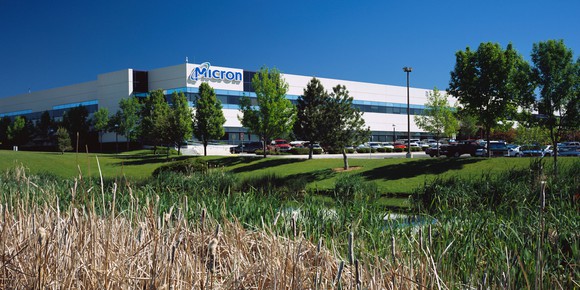
A Micron facility in Boise, Idaho.

Image source: Micron.

An about-face

Micron sold 29.3 million shares in October, raising $1.19 billion. The company used that money as part of a $2.25 billion debt-reduction plan, redeeming its 7.5% senior secured notes and 5.25% senior notes, both due in 2023.

This was probably a smart move. At the time, Micron had nearly $10 billion of total debt and about $5.4 billion of cash, cash equivalents, and short-term investments. The stock had soared nearly 150% over the previous year, driven by surging prices for the company's DRAM memory chips. The memory chip industry is cyclical, going through booms and busts. Micron using its elevated stock price to pay down debt when times are good makes a lot of sense.

What makes less sense, at least to me, is turning around seven months later, with the stock substantially higher, and announcing a giant share buyback program. This move reflects some extreme optimism on the part of management. Reading through the company's analyst day presentation, it's as if management isn't even entertaining the possibility of a downturn. Ever. They're projecting things out to 2021, and in some cases 2025, despite the company's poor record of forecasting industry conditions.

They'll either be very right, or very wrong.

What could derail Micron?

Micron's management is arguing that there are structural changes in the memory chip industry that will prevent the kind of wild swings in demand that plagued the company in the past. Demand for memory chips for use in data centers, self-driving cars, and the Internet of Things, along with stable supply growth, are expected to keep prices high and Micron's profits fat. If you believe that, buying back $10 billion of stock makes sense.

What could go wrong? A lot of things. Supply could ramp up at some point down the road as competitors try to steal away market share or simply take advantage of high prices. Analysts at Gartner are predicting a supply-induced downturn in 2019 driven by new capacity and China's entry into the market. Of course, Gartner is no more likely to be right about market conditions next year than Micron. But a slump in prices certainly isn't out of the question.

Demand could also fall short of expectations. Micron expects cloud data center annual capital investments to more than double by 2021 to $108 billion, driven in part by increasing demand for artificial intelligence workloads. Micron sees AI-capable servers growing from a tiny fraction of the server market to nearly half by 2025.

Those estimates will almost certainly be wrong, because forecasting anything related to technology seven years in the future is little more than guessing. Micron is also projecting that fully autonomous vehicles will require 74 GB of DRAM and 1 TB of NAND per vehicle by 2025, with 26 million vehicles equipped with Level 3 autonomy or higher shipping by that year. Maybe, but also maybe not.

Optimism can be dangerous

Overoptimism about future sources of demand is exactly what causes oversupply, leading to plunging prices and vaporized profits. Micron's massive buyback program comes at time when the company is enjoying one of its strongest periods on record. It's betting that this period won't end, going against the entire history of the industry.

Micron could be right. Maybe something has changed about the memory chip industry. Maybe spending $10 billion on buybacks, seven months after selling shares at a lower price, instead of paying down debt further will work out just fine. But that's certainly not a bet I'm willing to make.

Monday, May 21, 2018

3 High-Yield Stocks Still Worth Buying

Often a high yield is an indication of a stock that's facing some sort of trouble -- but not always. If you take the time, you can find high-yield stocks worth buying if you look in the right places. For example, decidedly low-tech�Lamar Advertising Company (NASDAQ:LAMR), beaten-up midstream player�Magellan Midstream Partners, LP�(NYSE:MMP), and renewable power-focused TerraForm Power, Inc. (NASDAQ:TERP) come from vastly different industries. However, each of these high-yield stocks has a solid business and good growth prospects.

Not all advertising is going online

Chuck Saletta (Lamar Advertising): A key premise of advertising is that you want to reach people where they are, when they're there. These days, many advertisers are going online to reach people on the internet or their mobile phones as entertainment shifts to digital forms. Still, the one place where the digital world isn't likely to replace existing forms of advertising is the open road. That's where Lamar Advertising, a real estate investment trust (REIT) that specializes in billboard advertisements, shines.

The word yield spelled out with dice sitting atop stacks of coins

Image source: Getty Images

As a REIT, Lamar Advertising is required to pay out at least 90% of its income as a dividend. That assures that as long as it remains profitable, it will pay a dividend and will likely have a fairly high yield. Its current yield is around 5.7%, and it recently increased its quarterly dividend by around 9.6% to $0.91 a share. Its dividend is generally well covered by its operating cash�flows, giving investors reason to believe those dividends can continue.

Analysts expect Lamar Advertising to be able to continue to grow its earnings by around 3% annualized over the next five or so years. While that's not exactly the fastest anticipated growth around, it should be enough to keep up with the currently expected inflation rate.�Combine that modest growth with its hefty yield, and investors buying today have the potential for a decent total return over time.

Down, but not out

Reuben Gregg Brewer (Magellan Midstream Partners LP): The midstream oil and gas sector isn't feeling the love from investors today, with the Alerian MLP Index down roughly 45% from its 2014 highs. The pain hasn't been quite that bad at Magellan, which is down just 20% from its 2014 peak.

Some midstream players have gotten themselves into trouble (often leading to distribution cuts) by taking on too much debt in a quest for growth. But the negative industry sentiment pushing Magellan's shares lower really doesn't have much to do the partnership's performance. In fact, Magellan's business has held up quite well, allowing it to raise its distribution every single quarter since it came public in 2001 -- notably including every quarter since the 2014 pricing peak for the sector. As for leverage, Magellan's debt-to-EBITDA ratio sits near the bottom of the industry.�It remains as conservatively run today as it has been throughout its history.� �

MMP Financial Debt to EBITDA (TTM) Chart

MMP Financial Debt to EBITDA (TTM) data by YCharts.

The future looks fairly bright, as well. Magellan has plans to spend $1.4 billion on growth projects in 2018 and 2019. The projects have customers already lined up or are at facilities where demand shows a need for expansion. This spending is expected to lead to distribution growth of 8% this year and between 5% and 8% in 2019 and 2020. Distribution coverage, meanwhile, is projected to remain a robust 1.2 times. With a high 5.7% yield, Magellan is still worth buying, even if the broader midstream space is struggling today.� �

A dividend powered by the wind and sun

Travis Hoium (TerraForm Power): Renewable energy is the fastest-growing form of new energy worldwide, and yieldcos like TerraForm Power play a key role in making wind and solar developments possible. The company buys projects from developers, financing them with cash on the balance sheet or by issuing a combination of debt and equity. As assets are accumulated, they add to the cash available for distribution, which funds the dividend's ongoing payment as well as long-term growth.�

TerraForm Power currently has 2,606 megawatts (MW) of projects on its balance sheet with an average of 14 years left on their contracts to sell electricity to customers, ensuring a long-term stream of cash. It also has the benefit of having the backing of Brookfield Asset Management, which is the company's controlling shareholder and ensures the yieldco can grow its asset base and dividend in the long term. Brookfield acts like a backstop when acquiring projects, making sure the cost of debt or equity isn't too high, assuring that any acquisition will help grow the dividend. It already did that with the proposed acquisition of Saeta Yield, where Brookfield fully backstopped the $400 million equity offering.�

All of the wind and solar projects generating cash flow each year ultimately pay dividends, and the payout currently stands at $0.19 per share quarterly, or a yield of 6.8% annually. Given the growth and high predictability of wind and solar energy projects, plus the backing of a financing power like Brookfield Asset Management, I think TerraForm Power is a great high-yield dividend in the energy market, and it can ride the industry's growth for years to come.�